One goal of writing is to see fresh. Skim off the schtuff you are told or believe and actually see. To create not replicate a cliché. Which is not to say be a lone soul in the universe with Poet Voice Authority. But to be observant, frank and entertaining with a compelling way of presenting what is.
As hard as that is to describe, it’s harder to do.
To see fresh is to be renewed yourself. You can’t live obediently regurgitating and correctly…no I’m wrong. Some poets seem to Jekyll and Hyde. Furious, neurotic, anxious in person and calm in poem, or cheerful placid in person and goth horror in poem.
To write fresh, you need permission of that as an outlet, alertness in safety of page, however you feel confined or compelled to be while face-to-face or online. It need to be something valued.
To reassure and soothe and reinforce a system in poetry means perhaps it’s challenged elsewhere. On the page you can meditate on the world you want to exist, where there’s sublime old time patterns, a controlled mini-world of the poem.
Room for all kinds, right.
If poetry is a medicine, as Ronna Bloom prescribes, and a medicine is for one illness in particular, then people not ill in that way don’t find health through that. They need a different prescription of poetry. You need more playful chaos? You need more constraints? More affirmations? More revolution? Literary pharmacies are well-stocked for any condition.
The Notebook: A History of thinking on Paper by Roland Allen came out in 2024. It took a while for me to get into it. It has a lot of interesting facts but the premise is that the artifact of recording allows culture to shift, in science, art, cognition.
Through the page, the working memory can be anchored and passed to others in a more detailed sophisticated way than oral alone. The page is a tool for thinking, hobbling forward without being bound to working memory’s size. What effect does cheap paper have on art? It allows sketching. In The Notebook Allen relayed, p. 366,
“The MRI revealed that the control subject drew portraits using the right posterior parietal area, the brain’s facial-recognition module, with which we recognise people and judge their mood. Ocean was also drawing faces but, that part of his brain was quiet. Instead, the blood rushed to the right middle frontal area, associated with spatial awareness: the part of the brain whose usual purpose is to stop us from bumping into things as we walk. Ocean’s working mind, the scan revealed, didn’t consider the face as a face, but a collection of shapes.”
That distinction between the concept of a head vs. this particular lighting creating shapes on this particular set of shapes is something that makes a difference. It is not dispassionate so much as paying attention. Your mind can go a thousand places but the pencil, one place at a time.
He, NG, whose name is cursed, in the before time, said that there is a difference between how you read a novel as a reader vs. as a writer.
There is a way of being in the world when you gather for the mill instead of walk and listen.
Sometimes we rush to conclusion/product/poem too soon. Black Wolf by Louise Penny had some quote to the effect that Gamache holds off as long as possible of deciding patterns. Keep letting data in. concluding too soon is how you miss little aggregating truths.
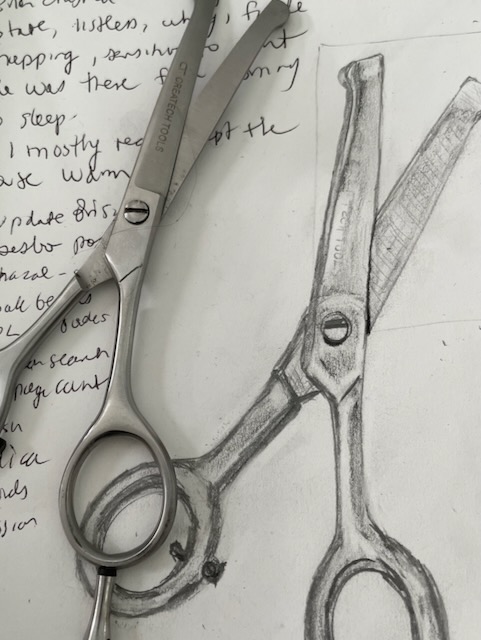
Writing is in part learning to pay better attention. Further to the drawing,
“[…]significant growth in grey matter on the left anterior lobe of the cerebellum, an area behind your left earhole that governs fine muscle control. Finally, they saw a difference between the brain of hobbyists who were merely good at drawing, and those who had enjoyed full-time training.
Art school attendance yields an area of denser grey matter in the right precuneus, an area toward the top and back of your skull that deals with visual imagery a three-dimensional forms.
By comparing their work with other studies, [Dr. Rebecca] Chamberlain’s team can postulate that six months’ training would not be enough to build up this grey matter: three years of training and regular drawing practice would. Typically, Renaissance artists were apprenticed for three to five years.”
p. 369, The Notebook: A History of thinking on Paper by Roland Allen
It takes daily practice to see the connections behind how things are put together in dimension and shadow, perspective and texture. As they are. As much so for writing.
It is not just the showing up, but that does help. A distinction between dabbler and accomplished is the level of attentive analytical, observant engagement, practice. The curiosity of what makes something go. Taking it apart. The how and the why brings the next level.
In other finds, you can learn Latin online at Latin is Simple. Which is good because I mistakenly gave away my paper dictionary and haven’t found a decent replacement and two apps I’ve tried are terrible. And grade 10 Latin was a long time ago.
Also, Writing in Science is a deeper dive.