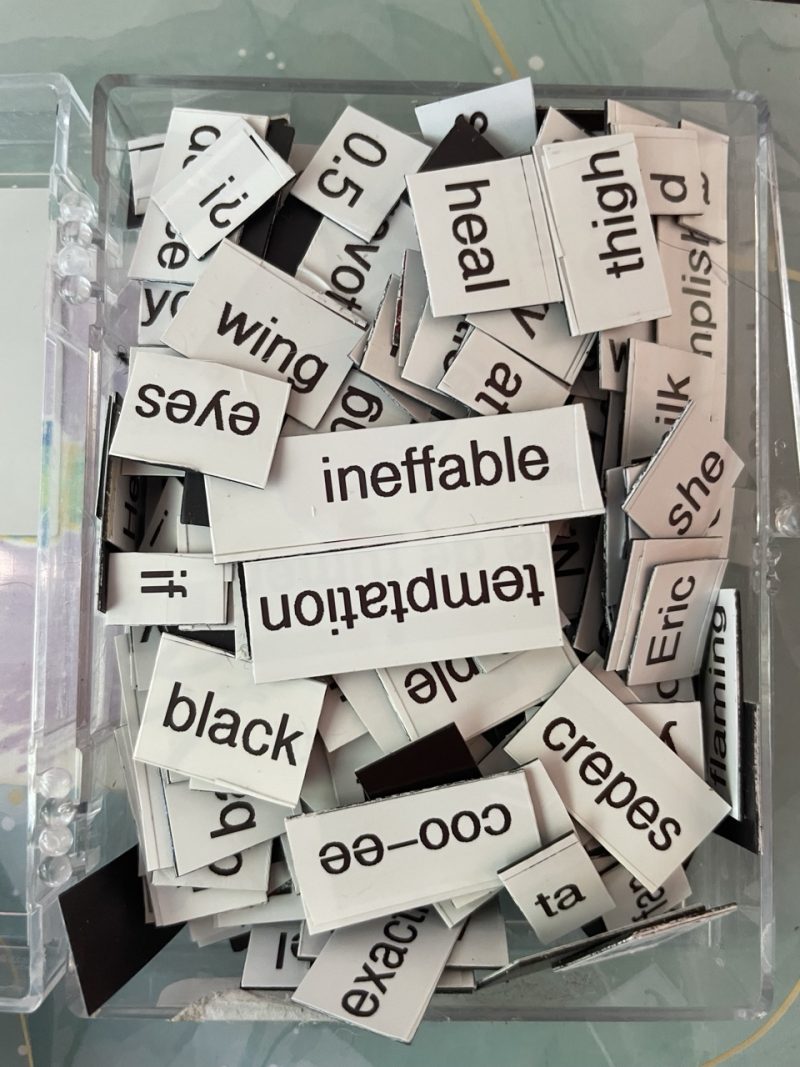
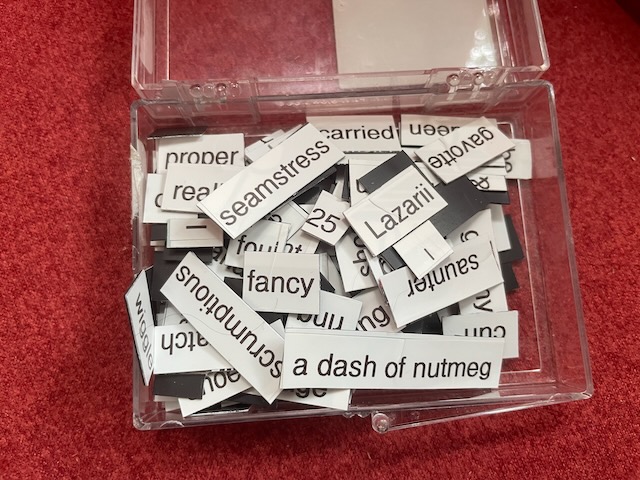
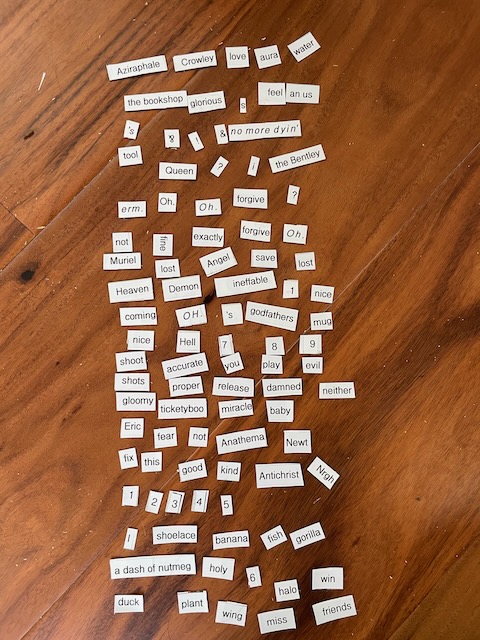
Here’s a DIY starter pack to print on magnetic sheets. It’s in Helvetica Neue, size 13, (when you want to add words to match).
Edit: Version 3. There are (3) 81/2 x 11 sheets. I rearranged some for best fit on page and voted some words off for better ones. 588 words/names symbols/affixes/suffixes in .doc and .pdf
I’m editing, editing. What could I do for break? I know…word games. There’s re-w-or-d-a-ble. (Not a sponsorship endorsement but word geek fun.) What else?
What do I like? Let’s see, poetry, remixing, chance operations, corpus studies, Good Omens and making stuff.
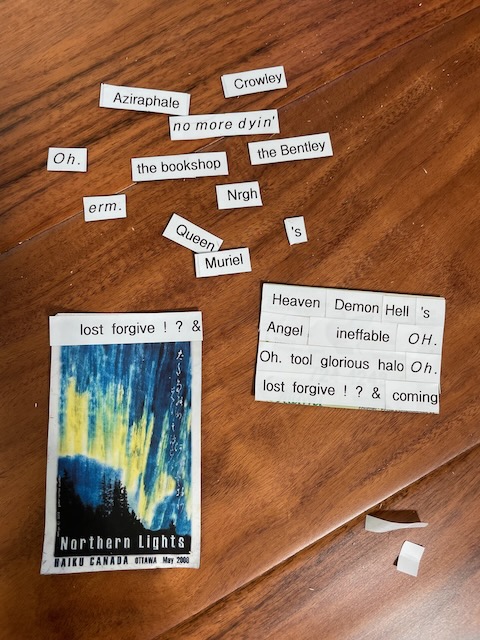
I have 5 sets of magnetic poetry. What if I made a Good Omens one? Which words are keyword bingo troped? I brainstormed some.
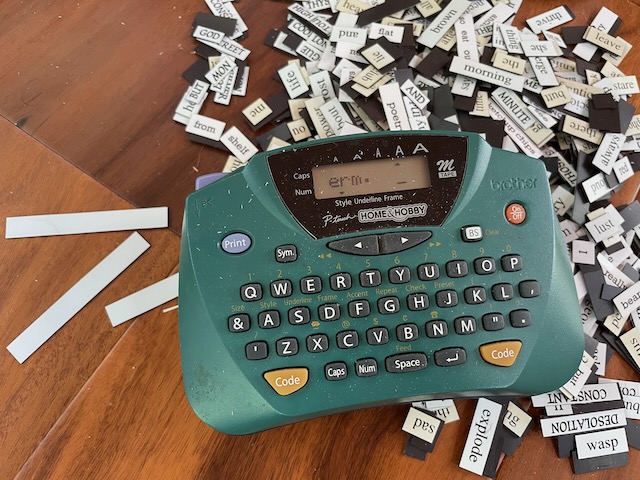
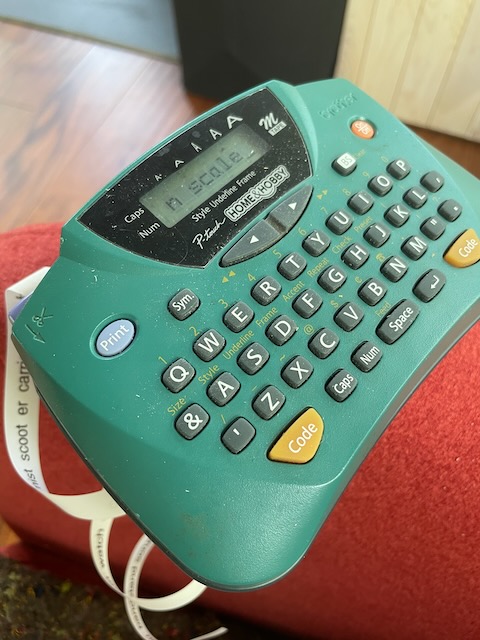
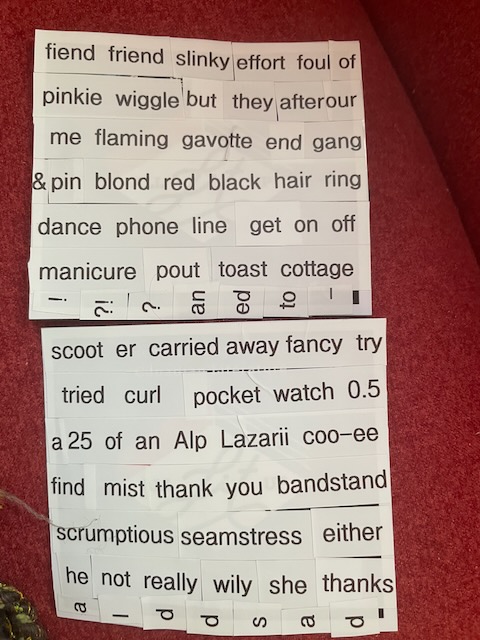
I have a base set, a gardening set, a CanLit set, a French base set, and some yellowed ones that I’m not sure what they were from. One of the sets came with blanks. And I have a labelmaker. We have a plan.
So I made a thing.
I have been setting aside those thin fridge magnets that advertisers send for 20 years or so (including ones from All Lit Up) and miraculously put them in the same place together.
If you have the same stuff, you’re set.
If you don’t, you can make your own set with 8 1/2 x 11 or A4 magnetic sheets which are thin and printable on, for $24 or so. Or heavier magnetic sheets plus adhesive paper for $12 or so more. You can google where. Probably Michael’s or other craft stores. (My computer thinks I’m in Europe so I can’t see Canadian inventory at places.
I could try selling kits but that’s a lot of work and shipping and sales and profit/loss, meh, and permissions, so I’ll copyleft it. If the Terry Pratchett Estate wants to make some, so much the better.
Here’s a DIY starter pack to print of 196 392 Good Omens words. It’s in Helvetica Neue, size 13, (when you want to add words to match).
Edit: I made two 8 1/2 x 11 sheets. Have fun.
Edit’s Edit: Good lord, I kept going. I’m done. (Surely.) Version 3. There are 3 sheets. I rearranged some for best fit on page and voted some words off for better ones. 588 words/names symbols/affixes/suffixes in .doc and .pdf
After the biggest concussion (aka the Year I Was Dead) and losing access to language and not being able to parse conversation, let alone poetry for months. After learning I have macular degeneration and that vision is even more ephemeral than life itself. After what I suspect was a mini-stroke a couple decades ago when I lost access to literacy, language, and numeracy for a few hours, well, after that, I go all in on reading, gathering what I can of lives different from my own, minds out of reach otherwise.
My brain is getting back its old speed and likes to have a lot of grist for its mill so the millstones don’t grind each other down. It works off my spare energy, especially when my body is non-compliant with my wishes for it.
As an extension of my shopping default —blue cheese or cream? Both. Or gouda? Take all the options— I complicated my life by adding this challenge to my reading rather than displace fiction, and non-fiction. It was a silly amount to attempt to read, even if half were chapbooks and Whitman was the push to finish the last 200 pages of Civil war era and end of life poems.
The thing about this richness of options, is among people doing Sealey Challenge is I see few books I recognize, or have read, among participants. There are just so many writers. I didn’t end up finishing a few I set up to read at the end of July (yet!) and, muddled duck, I seem to have read 34 instead of 31. (Not sure which days I did double.)
Someone, (was it Jason Christie, or Ryan Fitzpatrick?) suggested a poem a day for Sealey Challenge. That seems sound. (Maybe next year.)
I suppose I’ve read so much I glean for the saliant and suprise, not skimming but not dwelling and basking in each syllable and implication.
I read something like, 5300 pages in a month, 113 pages per book, ranging from 10 pages to almost 700. Week one was trying to wrap up books partly read scattered around and close those off. Half were chapbooks. But 47 titles in August. I feel like I character assonate myself by admitting that. Yes, I did do other things — regular life maintenance, construction, cooking, editing, managing book review editor crunch, volunteering, being first reader for a magazine — but also my body decided I need 6 hours sleep. So that opened a lot of awkward hours.
I aimed to complete 5 poetry collections in French. (Reach for the moon.) I managed 2. I forfeited attempts on 3 and read another poetry collection in translation. Some, like Dancing with Joy, were more than half poems I’d read before (not anthologized), and 5 of the 34 were re-reads so that makes the cognitive load different. But there’s these that I did complete:
Des Gouttes de lumière: häikus, par Carmen Leblanc, ill, de Valérie Albert, 2026)
edgeless by rob mclennan (Caitlin Press, 2026)
Chroma by Elee Kraljii Gardiner and Gary Barwin (Pinhole Press, 2026)
The Emperor of Japan by Dag T. Straumsvåg (above/ground, 2026)
i saved you a seat by Lauren Frederick (author, 2026)
the way home by Jamie Wimberly (Red Moon Press, 2026)
Mapless: poems by Kyla Houbolt (Shine, 2026)
Weeds of Canada by Dawn Macdonald (above/ground, 2026)
Between Two Dates: Haiku and Senryu by Kwaku Feni Adow (Mamba Africa Press, 2020)
Choral Coral Carol by James Lindsay (KFB, 2026)
Too Small For Meat by Barnabas I. Adeleke (author, 2018)
Leaves of Grass by Walt Whitman (Modern Library/Random house, 1892, 2001)
Origin Stories by rob mclennan (above/ground, 2026)
Songs of Kabir, trans by Arvind Krishna Mehrotra, preface by Wendy Doniger (New York Review of Books, 2011)
Letters Left Unopened by Paul Lee (author, 2026)
After by Chris Johnson (Paper Bill Press, 2026)
Just Saying by Rae Armantrout (Wesleyan, 2013)
Blind Painting by Robert Melançon, trans Philip Stratford (Signal/Véhicule, 1985)
Endangered Metaphors by George Swede (author, 2020)
Parasites of Heaven by Leonard Cohen (M&S, 1966)
Prospectus of Ambient Wonders by matthew burnside (Kith Books, 2025)
A Beginner’s Guide to Building Your Own Chysalis by Alex Cregan (Kith Books, 2023)
Running After Shadows by Hifsa Ashraf (Human/Kind Press, 2020)
Once Around the Sun: One Hundred Haiku by Graham High (Ram Publications, 2002)
Multimorbid by Rebecca Wood (Kith Books, 2026)
Grief is Not Shelf Stable by Jamez Terry (Kith Books, 2026)
S’agripper aux fleurs: haïku par Louise Canapé, Louve Mathieu, et Jeanne-D’Arc Vollant (Éditions David, 2012)
The Hobo by Phil Hall (Discord Review Press, 2025)
River Woman by Katherena Vermette (Anansi, 2018)
At the Gates of the Theme Park by Peter Norman (Mansfield, 2010)
Dancing with Joy edited by Roger Housden (Harmony Books, 2007)
Metaphysical Dictionary by Svetlana Lilova, illustrated by Graham Falk (Dumagrad Books, 2016)
without syntax by Lee Gurga (Modern Haiku Press, 2020)
The Loon Poems by Vera Lake (Flat Singles Press, 2025)
Parasites of Heaven by Leonard Cohen (M&S, 1966) most surprised because all his young man poems are different than his later poetry and what was gathered in his selected.
Many stretched my brain to read in parallel like At the Gates of the Theme Park by Peter Norman (Mansfield, 2010) with its surreality and darkeness beside Dancing with Joy edited by Roger Housden (Harmony Books, 2007) which was oddly familiar, bland and closed.
S’agripper aux fleurs: haïku par Louise Canapé, Louve Mathieu, et Jeanne-D’Arc Vollant (Éditions David, 2012) was most gratifying because reading the Inuit writers’ haiku in French was able to reach me, but Songs of Kabir, trans by Arvind Krishna Mehrotra (New York Review of Books, 2011) I enjoyed most thoroughly and am perhaps most likely of all to re-read. (Not withstanding I have reread a few of these already.)
*
In similar vein, I previously posted a list of 2026 favourites, but that was about halfway through the year and now we’re three quarters, or thereabouts, so here are new favs; many haiku, a couple poetry, some essays, some fan fiction and other novels.
Of what I read this month, i saved you a seat by Lauren Frederick (author, 2026) was most moving, and Multimorbid by Rebecca Wood (Kith Books, 2026) was heartening and relatable as disability poems. I also loved mclennan’s edgeless and Armantout’s Just Saying. It was just as good to reread Metaphysical Dictionary by Svetlana Lilova as the first and second time, and I still think everyone should buy it.
this summer’s best reads
Songs of Kabir, trans by Arvind Krishna Mehrotra, preface by Wendy Doniger (New York Review of Books, 2011) poetry
Turtle Dreams: The Red Moon Anthology of English Language Poetry 2025, ed. by Jim Kacian (Red Moon Press, 2026) haiku
No End in Strangeness by Bruce Taylor (Cormorant Books, 2011) poetry
tap dancing in my socks: haiku by Bill Kennedy (Red Moon Press, 2022) haiku
Operatives by Monty Reid (sider0xylon press, 2026) poetry
Lycanthropy and Other Chronic Illnesses by Kristen O’Neal (Quirk Books, 2022) novel
Garden-Body by Angel T. Dionne (ARC, X-R-A-Y Lit, fall 2026) poetry
at the airport terminal by bearwonder (A03, 2021) fan fic
Dear Ijeawele, or A Feminist Manifesto in Fifteen Suggestions by Chimamanda Ngozi Adichie (Alfred A. Knopf, 2017) essays
Let This Radicalize You: organizing the revolution of Reciprocal Care by Kelly Hayes and Mariame Kaba (Haymarket, 2023) essays
One Day Everyone Will Always Have Been Against This by Omar El Akkad (M&S, 2025) essays
Vanishing Culture, edited by Luca Messarra, Chris Freeland and Julia Ziskina (Internet Archive Press, 2026) essays
The Anti-Capitalist Resistance Comic Book by Gord Hill (Arsenal, 2012) graphic
I’m not sure if there’s any pattern you can draw from any of this but if your tastes align and you can find the following, you might want to grab any of these too. (Or anything from Kith Books.)
Because you know I keep track, here’s another set of personal accountablity stats for the spreadsheet geeks.
57% were read on paper over the year so far. (Paper is nice but hard to move around, easy to damafge, and trouble in dim lighting, and/or made in unfortunate sizes or choice of typeface.) (Compare this to 5 years ago when it was 68% paper when I was tracking this so I’d know if I’d mistplaced a file or a paper book.)
37 books so far were read aloud, compared to 47 read aloud in all of 2025.
About 10% were by GLBTQQ2+ writers that I know of, about 5% by trans writers that I know of.
Just over 60% poetry. About half of titles were by Canadian, 10% British, 35% American, 10% elsewhere and some unknown.
How did I source these books?
About half were free by some means which is kind of a requirement with the constraints of my appetites paired with my negligible income. Some I got from the library, some at the small press fair, some from my own shelves (flagged to read or reread), some from online, others from publishers, a few from authors, a couple thrift stores. (Only one I reviewed.)
That’s a poky trident. You can do it for yourself, for the community, or for the authors you are reviewing.
It is helpful to the reader/reviewer to read more deeply with intention to understand, to see patterns and reasons behind the writer’s choices. It makes you a more active participant, a more informed writer and it sharpens the mind. (Probably staves off senility like chess and word puzzles.)
It is valuable to engage with who you read, instead of moving eyes over the page towards the plot, be involved with the community that interests you. You elect to be part of the community. You provide service to the magazine, or blog, or wider readership by saying, look at this thing!
When you review you are drawing attention to something you read as worth more time and attention. Very few books get reviews or acknowledgement that they were made and published. It boosts the spirit of the writer to be seen. You are boosting its visibility by an increment.
No, it is fork, not a trident. Beyond building community in general, you are helping particular readers find their bliss, or avoid wasting their time on Definitely Not Their Bliss.
By what you choose to quote and comparisons made you build a matrix for someone to access whether they would benefit from reading it. By sharing your favorite parts, takeaways, sense of what was lacking, you are not able to change the book or the writer, (so stop scolding), but indicate to the review-readers, how well that match what they are looking for in this amoebic crawl we do through culture of yes or no to observe and absorb more material to digest and become.
What to include in a review?
People (other readers, publisher, author) like sound bites, and adjectives, a personal point of view rather than a list of table of contents, and page count. Compression is part of the art so it can be quotable, but a careful reading is more important than witty words.
The author is your peer, your equal, not someone you condescend to. The book is more likely to be a baby than an object so a certain amount of compassion and respect is appropriate. If it leaves you cold, not much worth saying, If it makes you mad, it’s triggering something from your hot-buttoned past, and consider that over the morality or skill of the writer you are reading.
A review is part of wayfinding. Few get paid for it. If you do make a critical “bad” review, courtesy is to not put it under the author’s nose with social media tags. Don’t @ them anywhere. Even if you think it is a kind review, it’s hard to know how someone else would interpret it. Maybe you call out their favourite bit as weak or omit mention of it. Maybe you praise what they felt guilty including but thought they could slip in. It’s all a bit precarious like any communication.
Someone not getting what you’re saying is normal, but let the engines of the publishers trawl over that and move on. You don’t need to engage with the author and the author doesn’t need to engage with you. A review is not an obligation. You probably will never get thanks, because like so much writing it is a thankless task, especially proportional to the time that went into it.
A review is communication at a couple degrees of a remove. The writer communicates to the page and you to another page. It’s a bit of an odd-duck dance.
If you resonate with each other, you may grow in each other’s regard. If you can’t hear them or they can’t hear you, that’s normal. But if you discover each other and animate each other, that engagment could be the start of something lovely, or a lovely experience in isolation.
What to include?
Ideally, to me, a review, quotes the work. Not too much as to be a spoiler, but the focus is on the work, so quote it. I don’t want your unsupported opinion nor decontextualized quotes. Say a thing, back up with an example. Study the thing. Reread. Take your time. You are here to learn not teach.
Cite page numbers. Cite publishing details of page number, publisher, price. Make a conclusion. Let your enthusiasm out or keep it neutral. Remember the sandwich rule. 2 positive bread for each neg. The point is not to only be positive but don’t scourge the thing/author. You are giving information not setting up a centre for your absolute monarchal authority.
The focus is not how clever or scathing or thrilled the reviewer is, like those recipe columns that derail into tangent on some relative’s kitchen as a child, or some trip to a prestige location. You can put yourself in the review, but as audience, not main performer.
What is the work about, in general that strikes you? What’s the prevailing mood or range? What’s your favourite section? How so? What aspect of it is strong? Consistency? Range? Sound? Rhythms? Arc? Personality? Unique point of view? Universality? What worked for you?
Be humble and be truthful. It doesn’t help if you say effectively nothing. It takes guts to put yourself out there and review. It’s a precariously visible position to make your observations known but the risk otherwise is to safely consume in secret and not add yourself to the mix. You miss out more in the bleachers, if don’t throw yourself onto the sport field.
It is too hot for words. Photos I can do. Have been doing.
Is it just me or is prose easier than poetry in higher temperatures?
5 days into August and I have two ghazals and 5 haiku written.
Mostly I’ve been reading. Chapbooks, single author collections, what have you. I’m doing the Sealey Challenge. Read poetry. Read diverse. Read daily. Start with your TBR pile or explore recommendations there. Or poke around in the Haiku Foundation Library. (Some are records of hard copies, some of viewable pdfs). The Book of the Week digitized archives could be a good bet.
I got, let’s call it, “too many” books from the library and want to close off a bunch.
And after more than 3 years in I would like to push through and finish Leaves of Grass, the longest version. I’m bogging on the civil war poems. He really gets caught up doesn’t he, loving the sound of his own voice, and not even following his own chosen topic.
I have finished and sent 4 reviews this week, although a few places are set to auto (out-of-office) replies. I’m hoping 2 books are en route by mail.
I’m beating the bushes for more people to review for Haiku Canada Review. We need more reviewers and more reviews. The timing of the next issue is before fall 2026 releases. I would like to do a winter issue of shorter reviews for our online arm as well.
I think all the manuscripts thrown at the wall have landed on the floor again so should toss them up again.