Pearl Pirie’s lists, reviews, interviews, etc. since 2005

Book Reviews

Why write a review?

That’s a poky trident. You can do it for yourself, for the community, or for the authors you are reviewing.

It is helpful to the reader/reviewer to read more deeply with intention to understand, to see patterns and reasons behind the writer’s choices. It makes you a more active participant, a more informed writer and it sharpens the mind. (Probably staves off senility like chess and word puzzles.)

It is valuable to engage with who you read, instead of moving eyes over the page towards the plot, be involved with the community that interests you. You elect to be part of the community. You provide service to the magazine, or blog, or wider readership by saying, look at this thing!

When you review you are drawing attention to something you read as worth more time and attention. Very few books get reviews or acknowledgement that they were made and published. It boosts the spirit of the writer to be seen. You are boosting its visibility by an increment.

No, it is fork, not a trident. Beyond building community in general, you are helping particular readers find their bliss, or avoid wasting their time on Definitely Not Their Bliss.

By what you choose to quote and comparisons made you build a matrix for someone to access whether they would benefit from reading it. By sharing your favorite parts, takeaways, sense of what was lacking, you are not able to change the book or the writer, (so stop scolding), but indicate to the review-readers, how well that match what they are looking for in this amoebic crawl we do through culture of yes or no to observe and absorb more material to digest and become. 

What to include in a review?

People (other readers, publisher, author) like sound bites, and adjectives, a personal point of view rather than a list of table of contents, and page count. Compression is part of the art so it can be quotable, but a careful reading is more important than witty words. 

The author is your peer, your equal, not someone you condescend to. The book is more likely to be a baby than an object so a certain amount of compassion and respect is appropriate. If it leaves you cold, not much worth saying, If it makes you mad, it’s triggering something from your hot-buttoned past, and consider that over the morality or skill of the writer you are reading. 

A review is part of wayfinding. Few get paid for it. If you do make a critical “bad” review, courtesy is to not put it under the author’s nose with social media tags. Don’t @ them anywhere. Even if you think it is a kind review, it’s hard to know how someone else would interpret it. Maybe you call out their favourite bit as weak or omit mention of it. Maybe you praise what they felt guilty including but thought they could slip in. It’s all a bit precarious like any communication.

Someone not getting what you’re saying is normal, but let the engines of the publishers trawl over that and move on. You don’t need to engage with the author and the author doesn’t need to engage with you. A review is not an obligation. You probably will never get thanks, because like so much writing it is a thankless task, especially proportional to the time that went into it.

A review is communication at a couple degrees of a remove. The writer communicates to the page and you to another page. It’s a bit of an odd-duck dance.

If you resonate with each other, you may grow in each other’s regard. If you can’t hear them or they can’t hear you, that’s normal. But if you discover each other and animate each other, that engagment could be the start of something lovely, or a lovely experience in isolation. 

What to include?

Ideally, to me, a review, quotes the work. Not too much as to be a spoiler, but the focus is on the work, so quote it. I don’t want your unsupported opinion nor decontextualized quotes. Say a thing, back up with an example. Study the thing. Reread. Take your time. You are here to learn not teach. 

Cite page numbers. Cite publishing details of page number, publisher, price. Make a conclusion. Let your enthusiasm out or keep it neutral. Remember the sandwich rule. 2 positive bread for each neg. The point is not to only be positive but don’t scourge the thing/author. You are giving information not setting up a centre for your absolute monarchal authority.

The focus is not how clever or scathing or thrilled the reviewer is, like those recipe columns that derail into tangent on some relative’s kitchen as a child, or some trip to a prestige location. You can put yourself in the review, but as audience, not main performer. 

What is the work about, in general that strikes you? What’s the prevailing mood or range? What’s your favourite section? How so? What aspect of it is strong? Consistency? Range? Sound? Rhythms? Arc? Personality? Unique point of view? Universality?  What worked for you?

Be humble and be truthful. It doesn’t help if you say effectively nothing. It takes guts to put yourself out there and review. It’s a precariously visible position to make your observations known but the risk otherwise is to safely consume in secret and not add yourself to the mix. You miss out more in the bleachers, if don’t throw yourself onto the sport field.

Hot

It is too hot for words. Photos I can do. Have been doing.

Is it just me or is prose easier than poetry in higher temperatures?

5 days into August and I have two ghazals and 5 haiku written.

Mostly I’ve been reading. Chapbooks, single author collections, what have you. I’m doing the Sealey Challenge. Read poetry. Read diverse. Read daily. Start with your TBR pile or explore recommendations there. Or poke around in the Haiku Foundation Library. (Some are records of hard copies, some of viewable pdfs). The Book of the Week digitized archives could be a good bet.

I got, let’s call it, “too many” books from the library and want to close off a bunch.

And after more than 3 years in I would like to push through and finish Leaves of Grass, the longest version. I’m bogging on the civil war poems. He really gets caught up doesn’t he, loving the sound of his own voice, and not even following his own chosen topic.

I have finished and sent 4 reviews this week, although a few places are set to auto (out-of-office) replies. I’m hoping 2 books are en route by mail.

I’m beating the bushes for more people to review for Haiku Canada Review. We need more reviewers and more reviews. The timing of the next issue is before fall 2026 releases. I would like to do a winter issue of shorter reviews for our online arm as well.

I think all the manuscripts thrown at the wall have landed on the floor again so should toss them up again.

Poetry is Action

I know the adage poetry is that which does nothing, but please, let us not confine ourselves to such lazy cynicism. Poetry doesn’t have to ignite passion and action, nor refuse to.

Poetry can be whatever nudges meaning or lack of meaning as language touches a human tangent. Poetry can be in a breeze, or a glance, or a graceful action. My segue falters, but my pitch is this:

I know there’s a lot of places for discretionary spending, personal rewards, daycations, books of course, and throwing help at sites of hurricanes, floods, forest fires, wars, dangerous human rights abuses, and famines. 

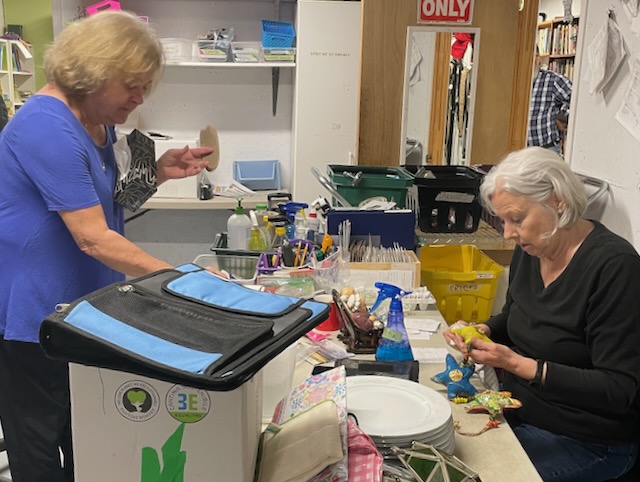
Between Maniwaki and Wakefield Quebec, there’s a charity shop that aims to make things accessible for all. Rupert Treasures. It’s where I’ve volunteered for several years. 

There’s none of this $15-$20 for a used vintage shirt business there. 

Prices start at a dime for ornaments, $1 for socks, might get up to $10 for a winter coat. It’s like shopping used in the 1980s. 

It’s priced at 10% of retail price as a general principle so everyone can have nice things, whether tools or toys, art, dishes or shoes, books, linens or DVDs. There’s a little free library outside, and a little free art library, and a community fridge run by the centre. 

And when there’s been another house fire, the people can arrange an after hours shop for free to get their household set up again. When someone’s in dire straights for whatever reason they can call and ask for a free shop. It happens. 

Sales go to the hospital, pet charities and people who discretely can’t pay for their meds, or groceries. They/we provide a load of local stop-gaps. 

Over 60 people volunteer over 1200 hours per month just on the sorting of donations from trash, recycling and rags. Then there’s pricing, hanging, bagging up sales. (A few people are paid there as well.)

Their description:

The Rupert Community Centre and Rupert Treasures need your help to fund the mandatory fire-code renovations required to keep our hall open and flourishing as a gathering space and community hub.

The Rupert Community Centre is a welcoming hub for residents of all ages that is run by a volunteer association founded in 1962. The hall provides an affordable space for a wide range of programs and activities such as baby play groups, ballet, yoga, fitness classes, seniors ’programming, weddings, funerals and community meetings. The association also hosts large seasonal events and operates the community skating rink and canteen, helping to create a safe and inclusive environment for residents to gather and connect.

Rupert Treasures Second Hand Shop, which operates from the basement of the hall,supports and empowers the local community by selling donated goods at accessible prices and reinvesting proceeds into community initiatives. This includes local employment, subsidies for non-profit health organizations, support for environmental and animal welfare organizations, as well as programming for families, children and seniors. From the beginning Rupert Treasures’ mandate has also been to provide assistance to families in distress and this remains a priority.

Their Facebook page has some event listings.

Being non-profit has a bit of problem when you’ve dispersed for the year and the fire department comes and says you’ll need x & y for a $100,000 to be up to code. Replace the ceiling, wall in the furnace, etc, etc. 

It’s wonderful to see people stepping up, donating proceeds of their kitchen parties, yard sales, bake sales, theatre piece, but the gap between coffers and incoming bill is pretty big. 

The Low Down did a piece lately on the fundraiser. Under a percent has been raised of the goal so far.

If you can, give a donation to Rupert Treasures.

And thanks for getting involved where you are, giving what you can in the ways you can. No one has to be responsible for everything, one moment at a time.

Revision

an accurate cigarette: poetry & prompts by Sarah Burgoyne (above/ground, 2026) has prompts and her responses to them.

I’ve been going through that, generating poems in this wild bit of heat and storm we find ourselves in, within a side of vertigo (to go soon I hope).

One of her prompts was take a rough draft and translate it. The overall theme of chapbook to keep in mind is “Add a warrior to it” as feedback she got once.

I searched files of poem drafts for July, and found an underwhelming poem in July 2021. Aha. A basic, I-am-bored-and-nothing-is-happening interstitial self-indulgent poem.

the white noise

between stations

of the b&w tv smaller

then a tablet screen

halfway between

two shows listening

to both. the snow

in mid-summer

a cooling focus

from the fly buzz  

It’s been a while since I did homophonic translation. Machine translation is too good and too AI to be useful for adding the chaos factor but I can work more from ear.

So I then subject it to pretending what I’m hearing and transcribing sound by sound is a muffled French. See if I can “overhear” anything vivid.

des whitérite noix

et patin stations

odeur baver sur des evenements à smala

dans un tabletter screau

il y as un oui beton

tu as choisis… les quoi? tiens, et

deux boits. les nons

sont fais à midi, et ses meres

as culé, focus

pomme de poing, il s’est fait flinguer

Then I translate back to English and see if I can take this randomness and reassemble towards sense.

meteorites, beer-nuts and bench rest stations


we are tourists in our own lives. may as well order the Beavertail.
the scent of our tribe at events is sour as unwashed sheets,
skunk sunk into the skin. we hover each other’s shoulders like
dragonflies, protecting against deer flies that draw blood.


we drool over a tablet, its five-left-sealed apocalypse.
we fall to kiss the ground as if  it were a yes in concrete
as if bumps on manhole covers were nipples of a Celtic king
to suck and pledge our fealty.

you chose yours, and drinks for two others.
the nos will come at noon with our mother’s dead-end focus.
an apple of a gist will get thrown. tossed back until it is brown pieces.
the tempting trees are sure they are tornado’s match.

So now although it is language-as-material-based content, it feels more distinctive and alive than the original. We have multiple people and interaction instead of poet-is-solitude-trope. We have particulars and actions. We have relationships to the world and to each other. It is less predictable. You don’t know where the poem is going when you start any given line. It travels. It is more of a wake up exercise but it pleases me now.

Rote as Anchor

There’s a certain inflexibility to a mind that replies with quotes, cited rules. But.

An antiquarian bookshop, Ageless Literature, posted about the cultural value of memorizing. The act internalizes a rhythm. Its breath becomes yours, and by repetition, you understand it more intimately. You can continue to access what is memorized and it can access you.

Ageless Literature, shared,

The Hungarian psychologist Mihaly Csikszentmihalyi argued that the default state of the human mind is not calm but chaos: anxiety, rumination, and distraction fill any silence the mind is left in. He called this psychic entropy.

A memorized poem gives the mind somewhere to go in those silences. It is one of the few activities you can do anywhere, with no equipment, to bring a restless mind back to order.

If you are stressed, you may want to ground yourself instead of building up to more angry or scared.

How? The funny thing is: the function matters, not the content. The act of focussing does the same thing. A head can’t spiral, panic, let an emotional tornado build in a box that small. It’s a sort of automatic sheepdog of the mind for the mind.

Count ceiling tiles, or calculate number of people in the room, or work out the next numbers of Pi, recite a favourite poem, or calming mantra, or recall a Koran or Bible verse, work out a new poem, throw yourself into woodworking to do something that absorbs attention, cook something hard. Or rehearse a worst case dialogue you’ve done a dozen or hundred times. Siphon off extra cognitive space that allows for rattle stuff the brain tight.

The anchoring touchstone can be memorization or making. It is a scaffolding when there is only a blinding disorienting chaos.
Make something: set to rhythm the Lord’s Prayer: our FAther who ART in HEAven, HALLowed be thy NAME.
Make a song set to the yellow rose of Texas: the YELLow ROSE of TEXas, she KNOWS the DUES I’ve PAID.
Or infill a line, keeping the rhymes from any sonnet, the points of structure and pivot.

In other words, keep busy. All things pass. Some too slowly like a certain person’s government position..