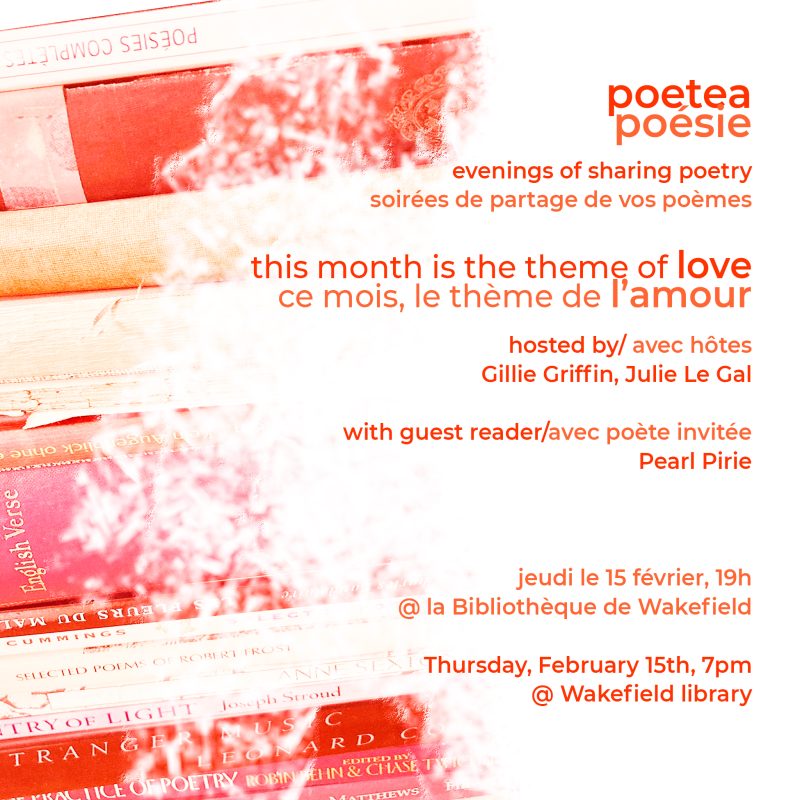
The chapbook A Couple Sumarians will get a launch in Wakefield Valentine’s day week.
Thursday Feb 15th, 7pm at Wakefield Public Library at the Poetea series. More details to come but wanted y’all to be the first to know.
writes.

The chapbook A Couple Sumarians will get a launch in Wakefield Valentine’s day week.
Thursday Feb 15th, 7pm at Wakefield Public Library at the Poetea series. More details to come but wanted y’all to be the first to know.
For the non-poets who do music
single = broadside
EP = chapbook
LP= trade collection of poetry
box set = collected works
compilation = anthology or selected works
track on spotify: set piece at mic
vinyl = letterpress
In my annual tradition since 2012, I share my self-audit of what I read and favourite reads. Throughout the year at instagram I have posted all the reads and some of the quotes from books I liked.
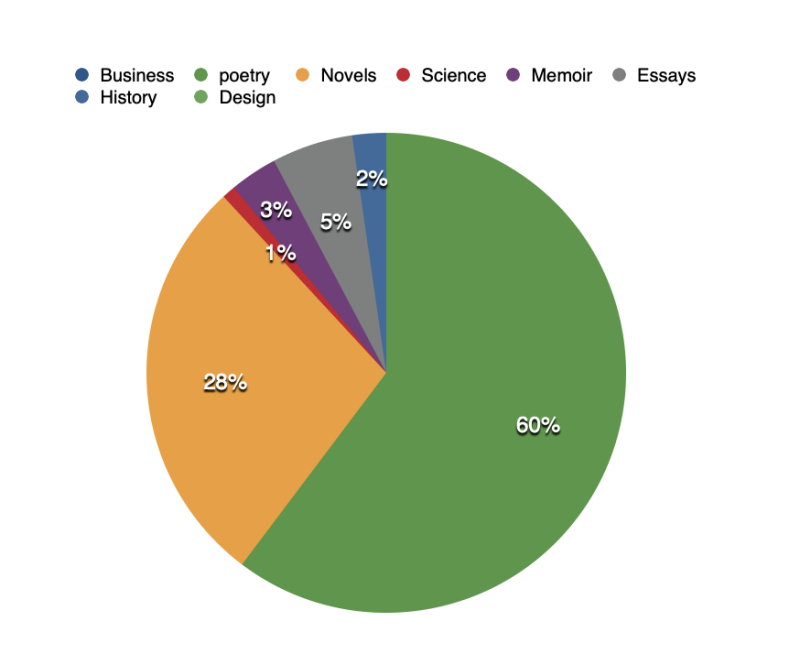
I aimed to read more fiction proportionally this year, setting aside some obsession with poetry. Intention didn’t translate. 57% of titles were poetry, so all systems stable, with 1% more poetry than last year. A fifth of reads were chapbooks (56 of them). I read 20 fewer titles than 2022. This year I reread 15 instead of 24 titles.
We read aloud 53 titles in 2023 so about the same as the 45 in 2022. Average book length was to 156 pages, compared to 132 in 2022 so total pages went up.
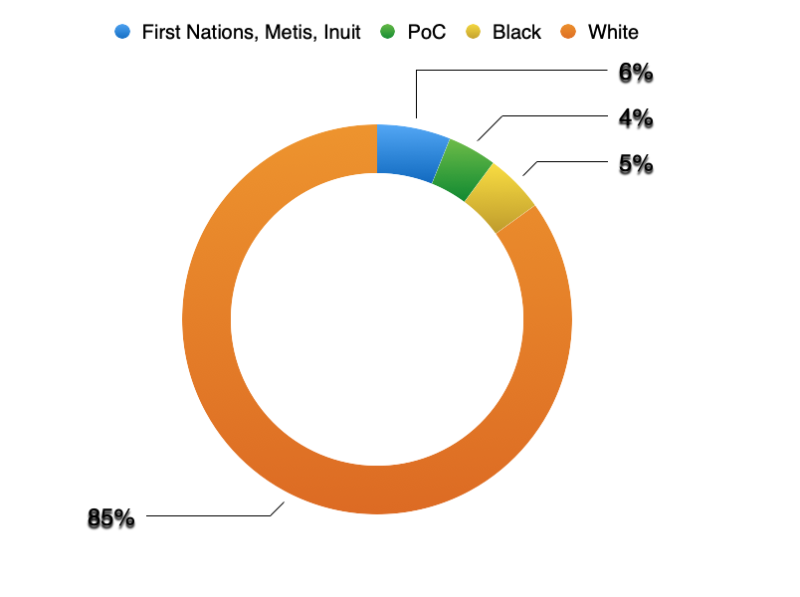
I read marginally more Canadian than not, almost half of all titles published in 2023 or 2022. Only 11 titles were from a century ago or more. 5% queer authors (11 titles, half the year before) and the same number were in translation, (about the same as last year). In reading diverse I did worse, with 88% white, instead of 80% although for some fan fiction reads I don’t know gender and I presumed whiteness.
Source was a turnover this year with to spot being nearly a fifth from the Evil Empire of Amazon, compared to 8% Amazon in 2022 being beat out by the library, publisher, used book stores and review copies.
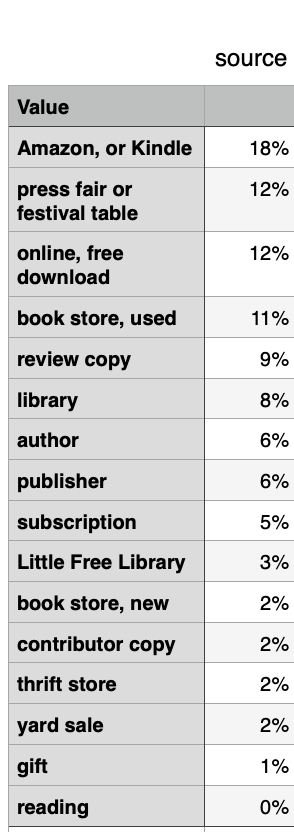
The source hierarchy for 2023 was Amazon, small press fair, free online, used book store, review copy, then library at 8%, with direct from author 6%, and direct from publisher another 6%.
I persisted through diminishing returns more often, valuing 4% at one star out of 5, instead of 1% the year before, but for that I blame the cat sitting on me more, with nothing else in reach.
I was blissed to a 5/5 star a fifth of the time. (Some of that can be seen in the 22 book reviews I did over the year. )
Some blazed then faded so demoted on the list. Some were 4/5 and persisted in my thinking thus were promoted.
The following are my 5 star-reads. This which could be taken as a recommended list, for what use it may be. It’s roughly unorganized but with the first two in each category as my top picks. They are generally marked by loving contemplative incisiveness, density, and the freshest of language that surprises.
Poetry New:
If I didn’t Love the River: Poems by Robert Priest (ECW, 2022)
Alternator by Chris Banks (Nightwood, 2023)
Broken Dawn Blessings: Poems by Adam Sol (ECW, 2022)
Only Insistence by James Lindsay (Icehouse, 2023)
Orion Sweeping by Anne Marie Todkill (Brick, 2022)
Tilling the Darkness by Susan Braley (Caitlin Press, 2023)
Time is a Mother by Ocean Vuong (Penguin, 2022)
The Ash Bell by Phil Hall (Beautiful Outlaw, 2022)
Poetry, backlist:
Beyond the Flames by Louise Dupré, trans by Antonio D’Alfonso (Guernica Editions, 2014)
Deepfake Serenade by Chris Banks (Nightwood, 2021)
Almost Spring by Nelson Ball (Mercury Press, 1999)
In the Silhouette of your silences: poems by David Groulx (Now or Never Publishing, 2014)
My Banjo and Tiny Drawings by Phil Hall (Flat Singles Press, 2015)
the weather by Lisa Robertson (New Star Book, 2001)
Half-Finished Heaven: Selected Poems by Tomas Tranströmer, trans by Robert Bly (Graywolf, 2001)
Field Notes for the Self by Randy Lundy (University of Regina, 2020)
I Dream Myself into Being: Collected poems of John Thompson (Anansi, 1991)
Catalog of Unabashed Gratitude by Ross Gay (University of Pittsburgh Press: Pitt Poetry Series, 2015)
Poetry Chapbooks, new:
320 lines of poetry by Chris Johnson (Anstruther, 2023)
Fossils you can Swallow by Vera Hadzic (Proper Tales Press, 2023)
West Coast Shorts by Laura Kelsey (above/ground, 2022)
Mayfly, issue 74 and Mayfly: issue 75, summer 2023 (Brooks Books, 2023)
Poetry Chapbooks, backlist:
Breakfast with Herons by James Hawes (Mansfield, 2019)
Spøkjelse I Japanske Drosjar by Dag T. Straumvåg, translation of Michael Dennis (A+D, 2020)
Nelson by Dag T. Straumvåg (Proper Tales Press, 2017)
The Birthday Party, The Mariachi Player and the Tourist by Susan J Atkinson (Catkin Press, 2021)
Surface Area by Terese Mason Pierre (Anstruther Press, 2019)
Novels and Novelas, new:
The Very Secret Society of Irregular Witches by Sangu Mandanna (Berkley, 2022)
The Book of Rain by Thomas Wharton (Random House, 2023)
Remarkably Bright Creatures by Shelby Van Pelt (HarperCollins, 2022)
Warrior Girl Unearthed by Angeline Boulley (Henry Holt and Company, 2023)
Or Be Nice by Charlotte Madison (Archive of Our Own, 2022)
The Last Unsuitable Man by Louise Carson (Signature, 2022)
Novels and Novelas, backlist:
The House on the Cerulean Sea by TJ Klune (McMillan, 2020)
The Dispossessed by Ursula La Guin (1974, audio)
Photographing Fairies: A Novel by Steve Szilagyi (Random House, 1996)
Firekeeper’s Daughter by Angeline Boulley (Squarefish, 2021)
Lovestar by Andri Snaer Magnason, trans by Victoria Cribb (Seven Stories Press, 2012)
Good Omens: The Nice and Accurate Prophecies of Agnes Nutter, Witch by Neil Gaiman and Terry Pratchett (Corgi Books, 1990)
Good Omens: The Quite Nice and Fairly Accurate Good Omens Script Books by Neil Gaiman (William Morrow/Harper Collins, 2019)
What We Make Of It (Shotgun Wedding) by Charlotte Madison (Archive of Our Own, 2021)
Rough Enough for Love by Nekhen (Archive of Our Own, 2021)
Gulliver’s Travels into Several Remote Nations of the World by Jonathan Swift (1726)
A Man Called Ove by Fredrik Backman, trans by Henning Koch (Sceptre, 2013)
Non-fiction:
An Immense World by Ed Yong (Alfred A. Knopf Canada, 2022)
As We Have Always Done: Indigenous Freedom through Radical Resistance by Leanne Betasmosake Simpson (University of Minnesota, 2017)
The Nice and Accurate Good Omens TV Companion: Your guide to Armageddon and the series based on the bestselling novel by Terry Pratchett and Neil Gaiman by Matt Whyman (William Morrow/Harper Collins, 2019)
the book of grief and hamburgers by Stuart Ross (ECW, 2022)
How a Poem Moves by Adam Sol (EWC, 2019)
Want to get yourself some magazine subscriptions?
Or packages of editing from a wide range of poets? There’s a fundraiser for that. Stephanie Bolster, Stephen Brockwell, Julie Carr, Annick MacAskill, Otoniya J. Okot Bitek, Sandra Ridley, r fitzpatrick, Madeleine Stratford or Stephen Collis.
Meta-post not on Meta
I’m steering away from Twitter and FB to the degree I can. I do like Instagram tho. Even if it is owned by Meta. I don’t like ads parroting back to me a commercial version of what I’ve said. Terribly annoying.
I’ve given up on MeWe since it didn’t build steam. I’m on Blue Sky, and here obviously. It’s kinda nice to rebuild networks with a fresh start.
On FB I added people where there ended up being no to and fro. I only see when it’s their BD and that seems like a bad time to unfriend an unknown person. I suppose it’s time for another cleaning. It seems one should know more people. It also seems there’s only a couple hundred people at most one could reasonable expect to connect to in any way.
Anyway, I made a chatty post over at Patreon of life and lit.
And I talk about the small press fair happening tomorrow, and fairs in general, over at Substack.
Hope you’ll poke a nose over there. Don’t forget to email, I mean, if you know me.