Pearl Pirie’s lists, reviews, interviews, etc. since 2005

Looking vs. Seeing

One goal of writing is to see fresh. Skim off the schtuff you are told or believe and actually see. To create not replicate a cliché. Which is not to say be a lone soul in the universe with Poet Voice Authority. But to be observant, frank and entertaining with a compelling way of presenting what is.

As hard as that is to describe, it’s harder to do.

To see fresh is to be renewed yourself. You can’t live obediently regurgitating and correctly…no I’m wrong. Some poets seem to Jekyll and Hyde. Furious, neurotic, anxious in person and calm in poem, or cheerful placid in person and goth horror in poem.

To write fresh, you need permission of that as an outlet, alertness in safety of page, however you feel confined or compelled to be while face-to-face or online. It need to be something valued.

To reassure and soothe and reinforce a system in poetry means perhaps it’s challenged elsewhere. On the page you can meditate on the world you want to exist, where there’s sublime old time patterns, a controlled mini-world of the poem.

Room for all kinds, right.

If poetry is a medicine, as Ronna Bloom prescribes, and a medicine is for one illness in particular, then people not ill in that way don’t find health through that. They need a different prescription of poetry. You need more playful chaos? You need more constraints? More affirmations? More revolution? Literary pharmacies are well-stocked for any condition.

The Notebook: A History of thinking on Paper by Roland Allen came out in 2024. It took a while for me to get into it. It has a lot of interesting facts but the premise is that the artifact of recording allows culture to shift, in science, art, cognition.

Through the page, the working memory can be anchored and passed to others in a more detailed sophisticated way than oral alone. The page is a tool for thinking, hobbling forward without being bound to working memory’s size. What effect does cheap paper have on art? It allows sketching. In The Notebook Allen relayed, p. 366,

“The MRI revealed that the control subject drew portraits using the right posterior parietal area, the brain’s facial-recognition module, with which we recognise people and judge their mood. Ocean was also drawing faces but, that part of his brain was quiet. Instead, the blood rushed to the right middle frontal area, associated with spatial awareness: the part of the brain whose usual purpose is to stop us from bumping into things as we walk. Ocean’s working mind, the scan revealed, didn’t consider the face as a face, but a collection of shapes.”

That distinction between the concept of a head vs. this particular lighting creating shapes on this particular set of shapes is something that makes a difference. It is not dispassionate so much as paying attention. Your mind can go a thousand places but the pencil, one place at a time.

He, NG, whose name is cursed, in the before time, said that there is a difference between how you read a novel as a reader vs. as a writer.

There is a way of being in the world when you gather for the mill instead of walk and listen.

Sometimes we rush to conclusion/product/poem too soon. Black Wolf by Louise Penny had some quote to the effect that Gamache holds off as long as possible of deciding patterns. Keep letting data in. concluding too soon is how you miss little aggregating truths.

Writing is in part learning to pay better attention. Further to the drawing,

“[…]significant growth in grey matter on the left anterior lobe of the cerebellum, an area behind your left earhole that governs fine muscle control. Finally, they saw a difference between the brain of hobbyists who were merely good at drawing, and those who had enjoyed full-time training.

Art school attendance yields an area of denser grey matter in the right precuneus, an area toward the top and back of your skull that deals with visual imagery a three-dimensional forms.

By comparing their work with other studies, [Dr. Rebecca] Chamberlain’s team can postulate that six months’ training would not be enough to build up this grey matter: three years of training and regular drawing practice would. Typically, Renaissance artists were apprenticed for three to five years.”


p. 369, The Notebook: A History of thinking on Paper by Roland Allen

It takes daily practice to see the connections behind how things are put together in dimension and shadow, perspective and texture. As they are. As much so for writing.

It is not just the showing up, but that does help. A distinction between dabbler and accomplished is the level of attentive analytical, observant engagement, practice. The curiosity of what makes something go. Taking it apart. The how and the why brings the next level.

In other finds, you can learn Latin online at Latin is Simple. Which is good because I mistakenly gave away my paper dictionary and haven’t found a decent replacement and two apps I’ve tried are terrible. And grade 10 Latin was a long time ago.

Also, Writing in Science is a deeper dive.

Another couple weeks

before the Hills’ Almanach des Collines launch. It launches on Friday February 6th at 6:30pm at the Wakefield Public Library.

Almanach des collines
The Hill’s Almanach

Craig Commanda
moose spine / glass beads

névé dumas
échos d’une colline

Ariane Roberge
2082 / 2109 / 2286

Finn Douglas Drake
bridges

Pearl Pirie
history flashes / recipes / ads / did you know?

Hannah Kaya Sideris Hersh
field manual / recipes

Dalie Giroux & Amélie-Anne Maillot
bestiaire

Ilse Turnsen & Marianne Labonté
fieldguide

Genevieve Cloutier
chairs

Madeleine Cloutier-Lynch
one after the other

Hannen Sabean
the heavy coffin

anya
in the summer we can only go out at night

Marc A. Reinhardt & névé dumas
édition / impression

Jamie Ross
faerie magick

and by then you could have your copy of the latest…

Two Timing: a two-person renga by Pearl Pirie and Chandra (In House Press, 2026)

make me an offer…or tradesies.

So glitchy

I woke up this morning with a sound track…

“Why are you doing what you’re doing? Why aren’t you doing what you love?”—Danielle K. Gregoire

I made a simpler, more streamlined menu for the website here and deleted the whole menu and could not get it recovered. Rebuild. Fine. There goes that afternoon.

I made a poetry file ready to upload for free download and it is too big to upload. That fits the day perfectly. Perfect to chase a night with vertigo. And I’m cold again because I let the fire go out. Somehow power cable around my legs and yanked computer off the couch as I got up for kitchen timer. Not actually killed it. This on top of spilling water in my keyboard by drinking and missing my own mouth, and later cutting my hand with tin foil, all of which brings royal us to nominate today retroactively into shoulda stayed in bed.

I tried reintroducing a tiny amount of nightshade to my diet. A few potato chips. My body’s joints immediately swelled and inflamed. That’s a no then.

Screenshot

Sometimes you think you have data, but not quite a complete set. I did not actually sleep 2 hour nights and vastly improve. I consecutively forgot to charge my watch so it kacked before morning.

At least I could write some. Averaging 250 poetry words per day, but most of the time is editing and cutting old words and seeing if there’s anything salvageable in bounced manuscripts.

I could learn mellow from this mouse.

In other news, Al-manach, a new anthology with risograph printing, showcases writing of les collines/the hills of Gatineau. It launches on Friday February 6th at 6:30pm at the Wakefield Public Library.

Deadline extended to Jan 31: Have you made a chapbook of haiku in 2024 or 2025? Or tanka, renga, senryu, sequences, haibun, and visual haiku? Send to the Marianne Bluger contest.

In the next pivot of attention…I like the ability of the internet to connect people of like minds or experiences and far distance. I like the critical thinking skills of people who make rather than only consume.

I like the free exchange of ideas and people who are curious to learn. People who declare they “don’t want to be influenced” worry me for that alone and for the mindset of proprietary insular ideas instead of community and growing together in an interdependent way. Aren’t we each isolated enough without deliberately avoiding listening to one another? It’s never made sense to me.

Further to the open access vs. capitalism, I present, the Mozilla Manifesto, which lists 10 principles which Mozilla believes “are critical for the Internet to continue to benefit the public good as well as commercial aspects of life”.

  1. The internet is an integral part of modern life—a key component in education, communication, collaboration, business, entertainment and society as a whole.
  2. The internet is a global public resource that must remain open and accessible.
  3. The internet must enrich the lives of individual human beings.
  4. Individuals’ security and privacy on the internet are fundamental and must not be treated as optional.
  5. Individuals must have the ability to shape the internet and their own experiences on it.
  6. The effectiveness of the internet as a public resource depends upon interoperability (protocols, data formats, content), innovation and decentralized participation worldwide.
  7. Free and open source software promotes the development of the internet as a public resource.
  8. Transparent community-based processes promote participation, accountability and trust.
  9. Commercial involvement in the development of the internet brings many benefits; a balance between commercial profit and public benefit is critical.
  10. Magnifying the public benefit aspects of the internet is an important goal, worthy of time, attention and commitment.

[via “Mozilla Manifesto”. Mozilla. Archived from the original on 24 June 2020. Retrieved 11 July 2020 via Wikipedia.]

Also from Wikipedia,

According to its founder Lawrence Lessig, Creative Commons’ goal is to counter the dominant and increasingly restrictive permission culture that limits artistic creation to existing or powerful creators. Lessig maintains that modern culture is dominated by traditional content distributors in order to maintain and strengthen their monopolies on cultural products.

Patterns that suck, suck. Break the status quo. Let’s make a better, kinder, world step by step.

Digital Chapbooks

(Got a comfy seat? This is a long one. Skim as you see fit. Or get a cup a cocoa and hunker in. )

Part of social media is to share what is useful, whether book lists, beautiful vistas, or safety information. To connect with dispersed people of shared interest or concern. It also means people of shared propensity to hate can get isolated together as well. It’s never the tool but the use that’s the key element.

This week I start to understand the people in the 1940s impelled to conscript against the threat to Europe as a threat to all. I hope in my lifetime there remains a Canada. I selfishly hope not to be personally bombed back to the Stone Age like so many places on this wee marble. I hope within 2 years the US has resumes dignified quality of life for those in the widening deluge of abuse. Trying times for the heart.

What to do, to do more for justice? For choice, connection, informed thought? How to live a more just life of worthwhile connection and help?

Often when I was crestfallen or angry a friend would cut me off and ask, what are you going to do about it?

How to move ideas and people is a concern.

We need to change the 1% and the pollution rate, and the incarceration rate and the zero sum solutions. And to think together without state threat.

Paper is a solution. An inane podcast whose name I’m redacting reported in the US 16% of people are readers and declining. The source they ran with (picked up under clickbait headline at People magazine) showed things more complicated than that — polling 200,000 people over 20 years, people read for longer at the end than the start, and there were regional, age and race shift disparities. I don’t know where to find the analogous figure for Canada.

I am deliberately insulated from the news cycle. (Being informed vs. sanity debate.) I want to live with intention and clarity.

I saw here and there recent notice of publishers saying they will no longer ship to the US. I noticed new difficulty and time to get books from the US. And finally the rigamarole of trying to mail books there myself, and consequently, I’m thinking, I like ebooks. They have advantages. Paper is not the problem. Context is the problem. 

Ebooks are easily transferable. Pay nothing or pay the same as print they are instant exchange. An unimpeded flow of ideas at a distance. Was that not the prime value of usenet and the internet and speakers corner in parks? Unlike talking their contents don’t undergo a telephone game.

It gets me thinking.

A recent poll on small press was money talk, income, a lot of key marketing lingo. The idea of art as pitch and product. The idea of conversation as paid subscription. Doesn’t feel right.

I will pay for a movie because it required hundreds of talented people, costing millions of dollars. 

What is the real cost of a book? Labour per hour isn’t measured. Volunteer labour by nature. A contract gives a symbolic gratuity of $500, if that. Reading tours may give more income if the series pays, with grants requested by writer and series. On a CV of publications and awards, the real income is peripheral to writing, editing, residency, teaching. All of which prevent one’s own writing. 

These impediments to moving books, this idea of small press as part of the real commodities economy jostles me about.

It reinvigorates in me the idea of poetry as shared life process, not saleable goods. Is poetry 50% hustle? Sholn or share alike?

Conceive hook and impact of a poem or work to place it in “the market”, as a frame, makes a poem an interchangeable widget. This is problematic. It objectifies something tender, careful, playful, vulnerable, ephemeral. An auction block doesn’t honour the spirit of poetry. 

Saw an ad for how art is not the main act if one is to “succeed” as a gallery — it has also taken the kool-aid of capitalism. Capitalism, which is to say to siphon money from working class to the rich, to accept hierarchies as is, to be isolated, specialized, part of the amused, obedient masses. 

Poetry isn’t always sticking it to the man. It is grown within systems. Selling and buying it seems shamefaced somehow.

So many conundrums to solve. 

Traditionally I tried to buy as much from poets as I could, spread an abundance not scarcity model. We are interdependent free-thinking equals not beholden to state, church or corporation.  We need to support one another.

Yes, we all have expenses. If we are subsistence farmers we are displacing time to write, and perish the thought, market, promote, and sell.

How to get Poetry to the People, apart from Wally or Stuart standing street side handing it out to those who don’t yet know they want it. 

If we as writers are low income we don’t have the disposable income to buy poetry at $25 a pop. Another conundrum. 

In isolation we are in the position to reinvent the poetic wheel because we aren’t educated on that the culture has moved to jets.

A solution is the trade economy, making and swapping. 

The trade economy isn’t a financial planner’s wet dream of continually arcing interest and ROI, scarcity model of hoarding driving up “value”. Some of us are habituated into understanding our value through the translating medium of money. If we give for free we are not valued or not honouring ourself with value. A trade economy is community over commerce. This is good. 

Freely offered time and help is automatic human culture, and allows society to cohere or at least be aware of one another.

As much value as there is in “Pay the Artist” if you can, free is also valuable. Libraries, gifts, Little Free Libraries, trades.

We are two people here. My partner works but my biggest personal income is dividends off a life insurance my parents bought when I was a baby. And I’m in a bubble economy. My local thrift store means I buy jeans for $2, a hot cocoa package for 50 cents, a bundle of pend for 15 cents, a winter coat for $10, books for 25 cents,  while out there… well, you know. 

Paper books are a pleasurable gratifying thing and can travel surprising distances,  but, looping back to initial concern, they are onerous and expensive to move. 

I badly want a bunch of the Red Moon Press titles from the US  but with shipping more than doubling costs, it hurts. $50 for an hour or two of reading. That’s not sustainable at my consumption rate. That’s an opportunity cost of a week of food. True it may feed the soul, but it also might vex the soul. 

Is poetry for connection? Transformation? For the underground alternate next culture or to sell pleasantries?

Haymarket Books and AK press and Microcosm Publishing press for distributing ideas in book form rather than selling a product which is books.

A UK haiku press, Snapshot Press, sells paper books and calendars but also makes gorgeous ebooks which have inherent value because of the editor’s eye making a large slush pile.

I see a few people sharing for free:

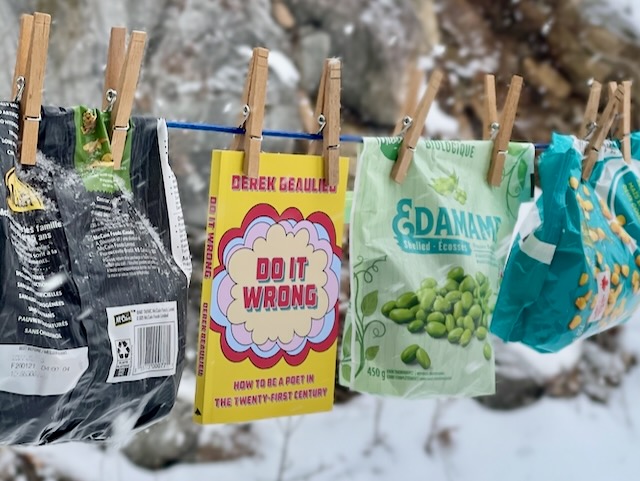
derek beaulieu’s opened his books for taking, under the tag, #BeYourOwnPirate with downloadable pdfs. He says,

I believe that releasing my writing online for free encourages new and unexpected ways of people engaging and responding with the writing; it  will encourage experimentation and reaction. I encourage authors to scan your publications & release them online as a free PDFs.

derek beaulieu

Model Press is one you can subscribe to from Ryan Fitzpatrick. It is an online-only poetry micropress now with 39 titles.

standard ebooks offers carefully rendered, typo-free, in good design of public domain, open-source classics, like Shakespeare, Langston Hughes, Mary Shelley, Charles Dickens.

Internet archive could let you borrow millions of texts from before the grievous takedown. I found books there that the authors and presses no longer have. They still are a portal to many libraries.

Project Gutenberg has all sorts of classics. Now that libraries supply the popular rather than archive the important. (No bitterness, much), we can access, at this point over 75,000 books in various languages. Have a 2 a.m. need for Paradise Lost? They got ya.

I have short had a list of resources, for teaching poetry, running a reading series, or laying out chapbooks. But of all titles of mine published or titles only one is listed of prompts. Most you only get to see in person. 

I have long an impasse at my website of covers and prices, but not the technical know-how to give a sample poem for each.

All this leads me to a new model. What if, in time forward, I make some physical chapbooks, but made them available as free downloads for greater accessibility.

I can start with out-of-print and presses that have closed. I have boxes of inventory unsold. I can start with what I do next. We’ll see how 2026 unfolds.

As my insoles profess, “every step makes a difference.”

New new-new new

Okay, new year, tidying, new things. You’ll see the header and its weird spacing is fixed. The pesbo logo has a refresh and isn’t stranded in space up there.

I updated the pearlpirie.com with chapbooks out of mine, and phafours press which I haven’t done in a year or two. Updated my 2024 CV. All sorts of things that probably only I would notice. Erasure exercise of typos. I tried to track down when I received grants. 2010, 2013 and 2014 it seems.

How’d that for burying the lede (my speciality). You can now buy Heat Lamp from me or from rob. I like how the cover and interior turned out.

It’s kind of concrete poems. Here’s a couple examples,