CBC shortlist for POETRY
Shane Book (Nepean, ON) for “Almost Spain”
Brian Brett (Salt Spring Island, BC) for “To Your Scattered Bodies Go”
Mathew Henderson (Toronto, ON) for “Oilfield Poems”
Gerald Hill (Regina, SK) for “Natural Cause”
Sonnet L’Abbe (Vancouver, BC) for “Permanent Resident’s Test”
Yay to Gerry! Them poet shoes go good places. And good to see Sonnet L’Abbe pop up. Funny that the one closest geographically is the least familiar name.

Pre-VERSeFest
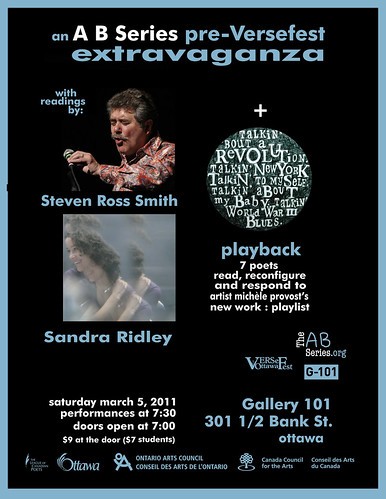
Steven Ross Smith and Sandra Ridley, Sean Moreland, Carmel Purkis, Grant Wilkins, Glenn Nuotio and Christine McNair doing a sound response to the Playback exhibit as part of AB Series Pre-VERSeFest.
The first few days of VERSeFest at a glance:
March 8: Ian Keteku, Brad Morden, David McGimpsey and Craig Poile (7 pm) and Michael Dennis and Ben Ladouceur (9 pm)
March 9: Beth Anne Fischer (7 pm) and Sandra Ridley and Chistine McNair (9 pm)
March 10: Mehdi Hamdad and Brandon Wint (7 pm) and Barry Dempster and Shane Neilson (9 pm)
March 11: Marcus McCann and Monty Reid (7 pm) and a dozen performers at Urban Legends (9 pm)
Check the site for it all but I’ll also mention Kado Ottawa is having a haiku presentation at 3:00 on March 13th too.
(Point)
Nice one! Thru this Fence, another link in the collaborative chain of 3-word poems. Like the pressure built in this too.
And, Lemon Hound’s series of people talking on reviewing has another entry, this one by rob mclennan who talks about getting into the context of the writer rather than stay in the shoes of the reviewer:
rm: I work very hard to understand a book on its own terms first, before moving out into the world. What is happening? Why does this book exist? What is it adding to the madness of books that already exist?
[…] I’m tired of seeing opinion pieces, of seeing book reviews that slag a title simply because the reviewer is using the work as politic, writing a polemic. I’m tired of watching a reviewer hate a work because it’s not part of what they like; who cares? So much reviewing feels like “I love clowns, Schindler’s List didn’t have clowns in it, therefore I hated the film Schindler’s List.”
I like reviews that seek to figure out the writing, be informed enough to know what the person wrote before and how it relates so they have a better vantage point for someone new to the name. There are hundreds of thousands of English poets. Someone who is reviewing should have more of a low-down on what we’re looking at than schlo-blow who can only orient to how he or she feels off the cuff.
Creating The Real Art Behind Poetry
Thanks to Rob Taylor for this food for thought:
In a country where people don’t gather in cafes, at ages where people don’t meet at university, how to meet other poets? The workshop.
The workshop answers the need for a cafe. But I called it the institutionalized cafe, and it differs from the Parisian version by instituting requirements and by hiring and paying mentors. Workshop mentors even make assignments: “Write a persona poem in the voice of a dead ancestor.” [etc] These formulas, everyone says, are a whole lot of fun. . . . They also reduce poetry to a parlor game; they trivialize and make safe-seeming the real terrors of real art. This reduction-by-formula is not accidental… Games serve to democratize, to soften, and to standardize; they are repellent. Although in theory workshops serve a useful purpose in gathering young artists together, workshop practices enforce the McPoem.
– Donald Hall, from his lecture “Poetry and Ambition”, which was later published in the Kenyon Review in 1983.
Fortunately the Pre-Tree workshops generally steer away from poem prompt assignments and more towards How Poems Work discussion or detailed round table crits, or drawing attention to particularly well-crafted pieces.
It can be boring to head dump yet another “spontaneous draft” and share the immediate slop. Exercises and assignments can make you write outside your default zones, although collections on a subject can inspire dreadful symmetry where each person cookie cutters out their brand of voice regardless of constraints or company.
On one hand one tries to create an essentialist self, polishing one’s own best fit of skills but if one isn’t challenging and expanding the toolbox, exactly what is one adding? Another poem which leaves the world unexamined? Another poem to reinforce hapless women feels upset and isn’t it romantic? Another poem in which we remix latinate vocab to be subversive? Another poem of a guy’s anomie of the open night hightway? Oh, look, heart string tug at standard second last line achieved? Another “true emotion“? Truth is an obstacle to communicating, isn’t it? Belief is largely a construction zone, much of comfort is wilfully ignoring parts of complex self that object to what the mind says, or the body or the heart. One integrated story to create an ooh is refined. Raw and fibrous and incomplete work too as poetry. And avant-gardists. It doesn’t need to be upheaval nor reinforcement, gratifying/satisfying, intellectual nor story, observations. Astute, purposeful even if unconscious, consciously filtered later, considered with brain and body and language engaged to nudge ideology towards complex understanding turns my crank.
One can fall into safe traps without the structure of obedience to parlour games and even in parlour games, people exceed appropriate limits, overshare, hit upon their own nerve accidentally, find something real. Or in project mind blather on because what is started must not be abandoned until funding comes to justify expenditures of energies.
I seem grumpy.
What impressive poems I thought recently and then could turn and also agree that the poet seemed a rape child of Sylvia Plath and Stalin. Sharp images, tight writing, sparkling metaphors, and an ideology of life is one bedraggled loss after the last. Can’t have it all.
Can have self-awareness tho. The poet’s job isn’t to slap down words unconsidered. There’s a social implication. A how one is treating oneself, how the words will be received. It’s a sort of terraforming that comes with some responsibility for keeping the standards up.
Being published is something, whether print or pixel but that damning thought that there is an audience of praise for everything and that doesn’t make something good or the top.
People call governments short-sighted but they are led by people. A general population which in a freedom of choice give themselves diabetes and heart disease and consume vacuous culture that have movies reinforcing unironically ridiculous gender-typing, have women hobbling about on tall heels and underdressed for winter while deafening themselves in clubs. Tastes of people to discern, in short, are short-sighted. People seem almost impervious to read implications or to take an active role in creating. So if poets want to elect themselves as meaning-makers or meaning-deconstructors, a burst of “real” defined only in emotional terms, in terms of ego, also has its problems.
To rebuild the sub-structure and the broken plumbing under culture, we need to analyze and question what is going on and sell a new story of how things are in a sugar pill that this sweet-addled culture can consume.
At least that’s the soapbox theory of the day.
Pivot

The MC at Pivot was Sachiko Murakami (of The Invisibility Exhibit (Talonbooks 2008).)

Fiorontino’s most recent book of poetry is Indexical Elegies (Coach House Books, 2010). They were much more rich than his previous book. Touching without there being harps and violins. He quipped about his shift westward from Winnipeg angst, wangst, to Montreal angst, mangt, but there’s more of a progression that that or else my tastes run darker than they used to. There were a few lines I wanted to retain that were washed over by successive lines.

Waving is Jon Paul Fiorentino. Carolyn Smart is rightmost. Her fifth collection of poems, Hooked – Seven Poems, was published in 2009 by Brick Books and is in the historical fiction sort of vein. Some on Bonny and Clyde and some on Elizabeth (no relation) Smart.
I found it fun to weave a new plaid thru my poems to make a different arc of composition. It’s nice to rearrange things on the gallery walls. It’s funny how tense I am in open mic with one do-or-die poem and given 20 minutes I can loosen and do improv swaps of what would fit the room better as I go. A set list of poems flies or fails but reading by mood with an outline to diverge from seems to give far smoother results. And I know the time for each poem so there’s none of this anxious glance about of dear-me-am-I-over-the-time-limit. Too bad I didn’t locate a squishy heart toy in time for this reading but there’ll be others.
It was a good-sized crowd, the chairs almost all taken when doors opened at 8 and a thicket of standing room only by start time. I’d guess somewhere around 50 people. It was great to catch up with some people I don’t get to see often enough or who I’ve only met on the page before. (I wrote more here.)
I brought some above/ground broadsides and about half were picked up:
this used to be a sestina by Fenn Stewart
Cone by Carla Milo
Helena relates by Pearl Pirie
Notes for a Sad Phoenician by rob mclennan
Getting ready for the long bike race, rob mclennan
(And I guerrilla scattered in transit stations.)
My moo cards got a few takers and I even sold 4 copies of been shed bore.
On March 9th Pivot highlights in Toronto Margaret Christakos, Adam Seelig and Mark Truscott.
Ah, Toronto, you’re always $150 away.