
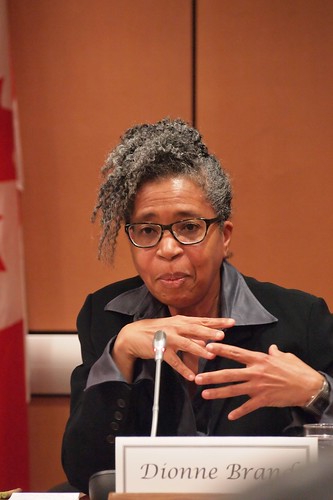
Nicole Brossard, Fred Wah and Dionne Brand fielding questions from the audience while on panel.
Parliamentary Poet Laureate Fred Wah organized this salon that to present The Political Poem with Nicole Brossard and Dionne Brand, “two of Canada’s most outstanding textual activists. Though the range of their writing is expansive, including novels, essays, collaborations, and films, their poetry and its impact has been particularly incisive in its ability to provoke the tangibility of issues such as gender, race, and social justice to our national imaginary.”
In opening remarks he mentioned that as part of his role, he’ll be bringing online over the next couple months videos of poets reading on the Parliamentary Library youtube channel. That’ll be something neat to watch for. The session was filmed and presumably will make its way to the same place.
Some was in French, some in English. I took notes but I’m unsure of how to represent that which was in French. My comprehension far outpaces my spelling or ability to reconstruct from notes. What is salient to one person is glossed over by another as familiar. Which is why the video in full will be a rich resource. But that said, here are some take-aways of what I got from the thought-provoking morning.
Fred Wah very articulately proactively deflected the paradox of being a free writer under contract to a government, He said that to write a political poem, under the auspices of the Parliament of Canada does not mean one is the government. Later Brand talked about the question of what we are complicit in, and the language we accept and deny. For example, we say in one breath, as do news commentators, we are bombing Iraq. Are we? Are we preventing it? Who is this construct of we and what do we say to it. In her book Inventory she said, “Let us at least admit that mean to do each other harm”. We need a clear-seeing.
Brand also remarked on how writing a political poem does not mean one writes about what news media calls topical news. It is broader than that. Brand pointed out that it is not the subject of a poem that makes it political or apolitical. If one writes about a flower, one chooses to direct attention to ecological values. (Likewise, if one writes about A Political Topic the real subject may not be the surface subject under the realization that things operate on various levels simultaneously, such as All public poems are personal. All personal poems are public.) She said that “any poem that intervenes into representation does the work of the poltical of what we see and how we represent the world.”

Wah also remarked on how the political poem is uniquely positioned because it fuses or enfolds passion and intelligence. Wah pointed out that Olsen combined the political with the common. He went on to say that most of the poetry that is worth reading is troubled, not with a general optimistic thrust. Think of To friends who have also considered suicide by Phyllis Webb, Call My People Home by Dorothy Livesay, The Blasted Pine by F.R. Scott.
If politics encampassed much, so does poetry more so. Brand said poetry’s defition extends to include the business of engaging the world and human interaction. Which humans? A challenge with poetry is that write towards something new. What is new is salient. The givens are already things we are conscious of. Complicating this said Wah is that you communicate with the people you gravitate to, who can hear you, who hold the same worldview and so what is a new idea outside the group is not within it.
The question of audience and communication looped thru the discussions. At the open mic the question of accessibility in poetry was raised. Brossard replied in part that she aims to always be “lucid and responsive and delirious and transgressive”. The first responsibility is to write what must be written, how it must be written. Brand also dismissed the idea of accessible that “we need to give ourselves full breaths of the collective of statements so large that they cannot be undermined, counted or killed. It is of no benefit to have one statement. One statement is precisely what is wrong”.
Which is to mean from the context of discussion that the problem of the political climate is an overly simplified presentation of the factors at play, the players at play, the arguments and the outcomes. It is made into a colouring book simplicity of them and us. There’s a danger in creating an us because by creating a we we create a them by default. We complicate those boundaries, question and efface those hard fast rules to get a model of the world which is more similar to what we actually see than what we see represented.

Quand le poète dit «je» tout le monde pense «nous » et quand le poète dit «nous» le collectif pense «je ».When the poet says I, people hear it as we. When a poet says we, everyone interprets it as I.
Poets in the writing are negotiating the question and boundaries of what is nous, what is us, what is country. Le pays qui nous transformons, ceci, n’est pas vestigial et nostalgie. The country is what we are making. It is not nostagia but more a matter of action. When we work at words we work at something which is virtual not concrete, but ton cerveau tambien, c’est virtuel, said Brossard. Wah added, as WCW says, only the imagination is real.
Brossard read from various works for 15 minutes including a piece which included the striking ideas about being in a sliver of dark donne moi un allumette […] un souffle me blesse […] donne moi un allumette et donne moi mon humanité. Give me a match and a breath will hurt me but give me a match you give me my humanity.
She later in the morning said, The we is contested terrain. Who is the we?
Brand said “the poet works in the unresolved spaces, not to find a solution but to analyze those moments and those possibilities”. “One does not need hope to continue. One’s work is language.”
“Poets, if to nothing else have a responsibility to language.” Fred Wah said and the idea was looped back to later in answer to the question of accessibility of poetry.
Dionne Brand characterized the political poem as collective one poem that pries against the forces and regimes that act to close life’s possibilities. She read from Inventory (M&S, 2002) where she confront her own sense of being perplexed by media systems that make war into a spectacle to consume, comment on, set in competition against Seinfeld or sleep. She wanted to move beyond the line fed by the televisual talk of difference to people. At the height of the Islamophobia, she went to Cairo. I may have mussed some lines here but the thrust of one part of that souk walk:
in that place where everything is for sale
he tried to sell me
nothing, […]only our common genealogy[…]
the silver meant nothing that moment that he called me cousin[…]
that word is more than father, mother […]
unexpected, so merciful.
What a striking idea that cousin is more than parents. We live complex relationships with parents, siblings, lovers, room-mates yet cousins are somehow a permanent kin bond, not troubled by the daily so there’s more room to cherish somehow.
At some point, she became aware that as a poet “one can only list, instead of suggest, imply, or infer. only to point, list and connect.” And she lists what she observes, for example a woman who “demonstrates a shot” in city x, meaning, becoming with her body the demonstration of what it is to be shot.
“there is no we now
it is too late for that.
there is nothing but to continue”
Brossard referenced Gaston Miron but in what context I can’t pull to mind or from the scrawl beside it.
By shuffling angles of language we try to catch new ways of being, new directions to proceed in. What does one need to say in poetry? Brossard said the most perfect line of poetry she knows is by Derek Walker “after this sentence, rain will fall”. It has within it the possiblity of the future. Secondly it shapes the air that follows it. If there’s something called hope, that might be it.
Interview at TCR with Nicole Brossard

Some chats after the Political Poems talks with Tania Aguila-Way, Erin Kean, and (unknown).

I was glad to see somewhere over 50 attend.

