Future of small press Ottawa poetry at seen at Apt 613 by rob mclennan points at two thousand pages of the Ottawa poetry pdf annual ottawater and calls for a literary book publisher to rise to complement the reading series and small press.
Future of small press Ottawa with Ellen Chang-Richardson, an organizer of Riverbed, points out all the amazing resources. The future is in the hands of who? “Anyone with the courage to write and perform it.”
Another In Our Tongues is coming soon. (Second Tuesday of each month.
64. A Sonic Boom of Stars: 2020 Southern California Haiku Study Group Anthology, edited by Beki Reese & Susan Rogers Southern California (2020) is a set of haiku, then a “foreign language” section including Spanish, a few haibun and then a chapter of haiku in a theme of windows. There are several outstanding poets but the haibun outshone the haiku in appeal for me. I seem to be on a storytelling kick. 65. The Ouroboros by Jim Johnstone (Knife Fork Book, 2021) is a really tight 5-page poem of the dystopia of the body of a city, what it confines and permits, and the walls within it between groups of people. 66. Peter Mark Roget: The Man who Became the Thesaurus: A biography by Nick Rennison (Pocket Series, 2007) is not a biography nor poetry. Roget is maybe 20% of the book, the rest being a James Burkian leap around the context and backgrounds of people and organizations tangentially related to him. It could be trimmed by 10% for long sentences and repetition. Interesting enough but not as billed. 67. Their Queer Tenderness by Neil Surkan (Knife Fork Book, 2020) is a gorgeous attentive little collection that I’ve already re-read twice. The lines pick their way carefully and surprise in their turns. For example, “a cumulous of blackberries” or “the wounded/ smell of clipped grass. Chemical/defence. Distress signal//to other grass” followed after a few lines by “Poetry//is such a wounded smell.” 68. The Gospel of Breaking by Jillian Christmas (Arsenal, 2020) is part anthem, part confession and rather exhilarating from her call out to the bike thief “canoe-douche” to aching love poems to a refrain of attending to her aged mother. Compassion and humour in a good ratio from “stealthy as a fledging emu who has had a touch too much mike’s hard lemonade” to a call out if those who spoke against robin williams who went though life despite depression when “every room you enter fills itself with/sharp objects pointed in your direction.” And poems of quiet reflection, considering how “the promise of possibility is a trap that has kept me from the joys of my own life.” 69. Undiscovered Country: new poems by Al Rempel (Mother Tongue Publishing, 2018) I have been trying not to read too fast and have largely been failing. They work in the long form build and reveal, in accumulation of quiet details so not very excerptible. It’s a quiet slow patio with tea, conversation without performance, but conferring how we’re orphans now, how funerals take up so much headspace, how “we should wait and see what comes after” in a world “lidded with a ceiling of leaves” where “our adult lives are gyroscopic, and by this I mean, we’ll do anything not to fall.”
Undiscovered Country by Al RempelThe Gospel of Breaking by Jillian Christmas
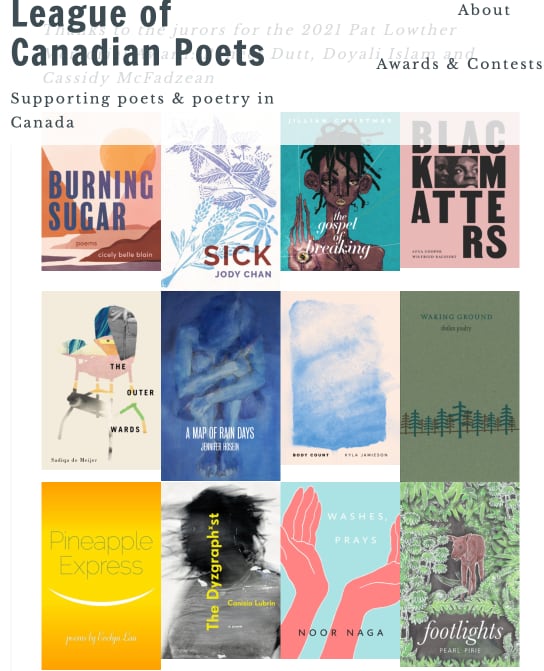
footlights is on the 2021 longlist for Pat Lowther Award, for Canadian women poets. The award carries a $2000 prize, and is sponsored by the LCP.
See the rest of the dozen excellent books at the League site, or below. Some of these are my favourites of the year, including Burning Sugar, the Gospel of Breaking, & Sick.
Phil Hall’s Niagara & Government (Pedlar Press, 2020) is on the list for the Raymond Souster.
2021 PAT LOWTHER MEMORIAL AWARD LONGLIST
Open to Canadian women, the Pat Lowther Memorial Award has been awarded annually since 1981 for a book of poetry published in the preceding year. This prize is in memory of the late Pat Lowther, whose career was cut short by her untimely death in 1975. The award carries a $2000 prize, and is sponsored by the LCP.
59. Purple Springs: A novel by Nellie L McClung (University of Toronto, 1921, 1992) was a wonderful read. I’ve had it on my shelf for years and we finally read it all aloud. So many great set ups of suspense of what’s going to hit the fan and yet the character Pearl brings out the best in people and finds common ground for people wanting to make the right decision for their own selfish reasons. It is the last chunky book in a series but it stands well alone. 60. The Lost Art of Reading Nature’s Signs by Tristan Gooley (The Experiment Publishing, 2014) has a great deal of unique information but jumps around like James Burke. The section detailing navigating by stars might fascinate some. He tries to cover the planet not just England but weather clues and lichen news are interesting. For all its fascinating bits, a bit of slog to get through. 61. Empire of the Wild by Cherie Dimaline (Random House, 2019) should have been top billed as paranormal. The cover of green chair makes sense after you read but didn’t exactly hook. The marvel of it zooms once I got past the first chapter. How it all fits together makes me gibbering and jaw-dropped. So interesting. 62. The Black God’s Drums by P. Djéli Clark (2018, Tor) is all male villains and all female heroes but written by a man. It is rapid and short, feeling like a short story at 92 pages, but is delightful in being a steampunk version of U.S. history where a slave uprising caused New Orleans to be a Switzerland of the U.S. during the civil war. 63. Finna by Nino Cipri (Tor, 2020) is a novella of pointed comedy for anyone who ever worked retail. The store is a knock off of Ikea and the characters timeslip through the multiverse.