VerseFest’s Indiegogo funding drive is 2/5 of the way to the goal. It has added a few more items, beyond pins, t-shirts, feel-good-feelings, festival passes and tax receipts…want a framed, handwritten poem by Karen Solie? By Phil Hall? Or how about Philip Levine? If you like broadsheets and limited print run, this may be your ticket towards literary memorabilia, and sight-unseen, I expect, a good poem.

On form and magazine function
ConduitCanada has an interview with Bardia Sinaee. It’s worth a full read. Here’s a couple snippets,
On “the resurgence on form poetry”,
Form never died or even faded, it’s just been mutating. How do we define or pin down the form of Berryman’s dream songs? I don’t think early post-modernism threw the formal baby out with the colonial bathwater. As universal things tend to do, poetic forms adapted by gobbling up the new, just as colonialism never died but incorporated universal awareness of its old tenets into a shiny new system of exploitation (and if your exports can’t compete in a “free” global market with subsidized American corn, then the IMF has a barbed dildo with your name on it).
and on the process of committee choosing a poem,
You’d think a large board might result in a broader range of poems being included, but it’s more like a venn diagram with ten circles–that is, any work that might be too “out-there” is not likely to survive.
A breath of fresh air, that fellow.
BQJ Launch and Fundraiser for Cornerstone

Jill Zmud (who you can hear on iTunes) was the featured music at the Bywords Quarterly Journal launch at the Manx Pub on Sunday the 27th. It was special not only because of her sweet music singing of the prairies and her a capella voice, that had half a dozen people I saw reaching for kleenex, but because it was a milestone launch.
Volume 10, No 4 marks 10 years of the Amanda Earl and Charles Earl team putting together a quarterly print magazine of the best of the online monthly bywords.ca poems. It also marks the last print issue. The online magazine will continue, with submissions open to Ottawa writers on the 15th of each month. The annual John Newlove Award for best of the issues will continue, but the paper end of things is over.
I have almost every issue of this iteration of BQJ and the previous Bywords print calendar with poems, back to the early 90s.
Honored to be in this issue, and able to make it to the reading were these 6 poets.


Dominique Bernier-Cormier and JC Bouchard were reading at the open mic, this being Dominique’s first public reading. Dominique’s words in cold beats struck me as he read: “how deep do snow roots go, mother? deeper than those beets.//what do you know about the horticulture of winter” Beautiful.
JC Bouchard got the rapt attention of the full house with a poem about Barbara Gowdy and macabre cadaver trail of the lines with a surprise ending that caused laughter.
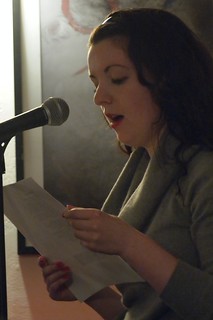

Heather Davidson and cb forrest
It’s always nice to see new and returning faces on the scene. Ottawa, swear is 1/10 poets by volume.
In Heather’s poem called Rimbaud there’s a part that struck me and it’s funny, reading it again, I see no trace of mother-daughter relationship that I heard in the air.
Shaving, I remember being insistent
in that house with no mirrors.
That she know not to cut my throat
like a cow in the marketplace.
It struck me the relationship of barbarous, barbaric and barber.
cb read one from the issue and another that tied in well with Bouchard’s in that serendipity that readings sometimes have. It has a similar movement, seeming to talk about the dark matter, in this case, isolation and disorientation of senility but it twisted at the end to relieve the audience with the sort of venn diagram of meaning that it could be that, or being lost at Ikea.

Catherine Ruth Taylor
Catherine’s poem, May the Second was all the small preparations made for another kind of leaving, a father on his deathbed and preparing the grounds and gardens for “after”. It is leaving in a different way in the sense that one can resist and regret in advance or embrace what’s left.
we harvested the beans and peas
but he was ill – we didn’t freeze them
we offered them for eating now with red wine
Despite being a death poem, and because of it, it felt life affirming.
At the reading, the usual hat was passed but this time it was the annual fundraiser for Cornerstone Women’s Shelter. For $30 they can feed a woman in need of emergency shelter for a week. For $100 they can do job training, get counseling. Cornerstone provides
- Basic needs including meals and roof
- Crisis counseling
- Goal planning, training
- Referrals, recreational & spiritual supports
- Mental and addictions supports
- Housing search or rent geared to income
Thanks to Ottawa’s generosity Bywords raised $536 for them, almost twice of what was raised last year.
When poetry, music and money come to the good of each other, it’s always a beautiful thing.
Thanks for all that you have done for poetry and continue to do with and for poetry Amanda. Ottawa is very lucky.
Dos and Don'ts for Author Bios and Photos
When submitting a bio and photo consider what these tools do for the reader or audience: they give an introduction. They are your pitch that runs ahead of you.
A lot of bios run like a dry version of a CV. It’s relevant to indicate experience but every bio is a list.
While accomplishments, awards and book titles are things to be proud of and demonstrate other people have found your art worthwhile, unless your titles are telling, the list alone doesn’t say why your work appeals. If your title is “Blue Water” it will indicate less of what you’re about and the genre than “The Zombie Survival Guide: Recorded Attacks”.
A bio is a hook on why someone should pay attention. A bio should also key people in to what you’re passionate about. Be as specific as possible: author also writes political satire and acrostics. Add a particular model of guitar or bicycle. Add something of favorite things. “Loves the way rain sounds coming thru white pine.” It adds a flavour of personality, perhaps tying into the motivations for living.
Your bio is an art form onto itself. It could be something personal, distinctive, and unique. “Author lives with 2 cats” is not unique. “I have been writing since childhood” is not distinctive. Maybe your writing is all about the domestic and “lives in X town with husband and 2 kids” adds a down-to-earth human element. Think about what impact the sentence can have.
Each bio can be a custom job. You may add a factoid, or teaser of connection. For example, to be published in a journal out of particular college, tie into the local angle: “The author was first kissed while living just outside this college town”, or “Author currently lives in this town which the writer first encountered stranded roadside in 1986”.
Do you write humour but your bio is sombre? Have fun with it. You can do that without feeling exposed or oversharing or being too random. Some journals demand dry, bland and meek. If so they will tell you.
Even though it is called a bio, it is a pitch more than an autobiographical short. What aspect of yourself do you want out there? What effect do you want? Your bio could plug future projects or your favorite charity. It could counterbalance the tone of your work or play it up. A poem about the prairies could be written in cowpoke theme. Hokey might be better than forgettable.
Each bio is a very small billboard ad. What key info to pique interest would you like to put on it?
And then there’s photos.
A photo should be big enough to be useable to allow for print quality, publicity posters, re-sizing to various screens.
A photo should look like you. Ideally it should help the person coming to pick you out of a crowd. If the last good photo of you was taken 30 years ago, it may be time for an update. A professionally done portrait is best.
There are hammy authoritative author poses or a simple head and shoulders, but flattering mug shot.
If you are going to do it yourself, here are some tips:
A posed portrait is often better than a candid so you are alert and at rest. Photos taken during reading tends to be of a stressed person mid-facial expression blurred in dark lighting.
You should be visible. It should be well-exposed not a grainy silhouette nor a large scene which you are incidentally in with the head the size of a pencil eraser.
A photo that frames the head and shoulders or upper half of the body is fine so long as your face is recognizable. Think of i.d. photos: no hats and their shadows, hair or sunglasses obscuring the face.
Use a non-cluttered background. Think of things in a photo like parts of writing. Are they adding a plot element, or distracting?
Do use a camera not a camera phone or webcam. The light from the screen tends to be blue and unless you were born blue… If you must use your webcam lift so it’s not the unflattering from-under-the-chin perspective, and fill your screen with red or orange background to moderate the colour cast. The arm holding camera looks like shoddy 90s Myspace. Cell phones tend to have harsh colors profiles and tend to be grainy and smaller scale.
Do: Be in natural light, ideally an overcast day outdoors or near a window.
Don’t interpret “by a window” to mean your back to it. Be 45 to 90 degrees or nearly facing out a window with the camera facing along the wall or into the room. This gives a soft even light without a dark side to the face. The cloudy day lighting also is kinder to wrinkles than overhead indoor light.
Don’t use a flash: If its attached to the camera it shouldn’t be used. It flattens the face not flatters. It blows out highlights, especially cheeks, foreheads and men’s bald patches. All the curves make the shape and if they are all black or white, it’s harder to make out the person.
Photo-art images to seem like oil paintings are fine so long as you don’t lose the recognizable-factor. If you want a more stylized portrait than a plain record of your bone structure without a hint of your personality, there are all kinds of skilled photographers who do that. For the price you get paid for some readings, you can get a portrait to use for years. (But not for 40 years.)
Most people don’t like getting their picture taken but a good photographer can make you feel more comfortable and get good results.
For those local I’d suggest John W MacDonald.
Ottawa Woman's Slam Championship 2013
The 2013 Women’s Slam Championship, presented by VERSeOttawa was at the Mercury Lounge Saturday, January 26th. With a $8 charge at the door, the downstairs and upstairs were standing room only. It was a good night with strong voices and stories. It was in the space that Capital Slam uses each Saturday night, including next week. Check it out if you can.

This championship was hosted by the inimitable Nadine Thornhill, who tied connections between pieces and added comments with her knack for the apt remark.
Over the last months there have been run-offs for who will compete. The 10 finalists to compete for slots were: CauseMo, Dimorphic, D-Lightfull, Kay’la Fraser, Freedom Writer, Emelie Jaquez, Kimbit, Missaralee, Jenna Tenn-Yuk, V, and (stepping in for Hannah Christie and Elle P) Zorah and Kate Hunt.
The volunteer judges were calibrated by a poem from the sacrificial poet,

Stargazer. In many of the performers there was strong stage presence, and in some cases intricate things with rhythm, internal rhyme and momentum. Most were memorized, some read from page or screen or used them as notes. I didn’t get a tally from the door but I guestimated that there was somewhere over 80 attending.

5 volunteer judges scattered around the room gave each poem performance a score out of 10. (You can see a couple white boards from here.)
Nadine read out the scores. If you didn’t like the score, you were encouraged to boo or call “higher” or to cheer the judges if you agree with the number.
The top and bottom scores are dropped and a score out of 30 for calculated for each poem. The scores from the first half and second half were summed to get a final score for the evening to see who was the judge and crowd favorite.

Each of the 10 did one poem each before the break and one poem each after the break. Jenna Tenn-Yuk‘s first piece was empathizing with her grandmother losing her husband. Her piece of the second set was about clubbing to dance while mystery men were crude and annoying and going to stay a mystery from as far away as possible.

Freedom Writer from the Junior Slam team started with a clear melodic song. She held a room with stillness rather than gesture and went at faster than auctioneer speed quiet and quick in a looping rhythm. She also did a more hip-hop rhythm spoken word about the boy of Uplands Corners who dreams of being a thug, who has a home but dreams of being homeless, encouraging him he can be more.

Kimbit did a piece on finding your religion and on finding a man on a bridge, contemplating dark places and hoping by taking time out her life to reach out and talk with him made a difference. You can never stop someone from dying but maybe you can to put it off for a while. She hopes that wherever he is that his “sky is less stormy” ans was urging people to connect with people because you never know your influence. A little friendliness can go a long way but so can a hard word. We’re in the world to help. “Does it matter who? Because you are them, and they are you.”


Zorah did a poem on ghetto heaven where maybe the angels that protect you have graffitied you name forever on an abandoned fridge. Her other poem was about and did some word plays, such as “I know love bites but I’m willing to suck out the venom”
Kate Hunt (right) did a poem about story and farming. She wove a chorus of “There is one road there and you have to help.” Isn’t that true. The only way back is communicating with the willing. In the second section she did a Boudicca poem woven with teenage angst of the storm clouds within also being visible without.

Emelie caused men around the room to sound out about her seduction of the one who has yet to come. “I’m sorry for all the time you were waiting for my arrival” she said in part along with what she’ll do with him to make up for the lost time when you thought you were ordinary. She can see the he is special and won’t go by some banal term but his real identity; “I will introduce you to my friends and family as Oxygen.” No thud of men swooning but presumably they were holding onto their chairs well enough.
Her other poem was a plea to a drug dealer to look past his short-sighted negative vision of the world and realize the hands of time are going to get arthritis and he can be more, as much as he can dream.


Kay’la Fraser is a comedian and can do all sorts of voices. Luckily, if you come to VerseFest’s top woman’s slam night you can hear her and Kimbit.
She started by singing “take me out to the..” poetry game and explained this is not a spectator sport. You all are part of the game.
Like many in the second set her second piece was sexual-spun. “I want to love you…so hard…that diamonds say day-am and I want to love you so slow…that it’s like two sloths giving high-fives”. The whole was hilarious.


Dimorphic intercut powerful singing (or sung prayer) for grandfather with a story of going to a native event. In the second round she gave a rallying anthem of how we need to remake gender fairytales for ourselves and our kids. “Glass slippers come with glass ceilings” she warned.
She said, we need stories where its girls who rescue lost boys, relieve them of their shining armour, help “them off their horses and teach them to stand on their own two feet.” It was tight at times. For example here, Dimorphic had a score of 29.9 but an overtime penalty (with half a point deducted for every 10 seconds over 3 minutes) left the score at 26.9.


D-Lightfull did the piece she did at Versefest last year of being addicted to a dick and another poem about being overly attached to a bad boy who’s no good. V (on right) for her first set did an angry poem on the same theme of people being attached to each other when they’re not good for each other. In it she dropped the phrase “I’m a phoenix born from this ashtray”. In her second set she did her poem about “I want to get my sex on” on the bus, and various places. The room erupted for both poems of her sets.

CauseMo also caused some foot stomping cheering at the end of her piece on make love to me, read the braille of my skin. In the other set she talked about love gone not quite right. “I don’t know how to love myself but I know that you’re doing it wrong”.


Missaralee (pronounced: Miss Sara Lee) is a dramatist. Her name was drawn from the hat to go second and opened with a strong explanation of No means no and all the ways no is and all the things that aren’t yes so that people who think anything but being punched is a yes get some clarification. Her other piece was a advertisement for consensual sex package for sexy beasts, guaranteed to improve sex lives.

In the end V took home the top spot but before she left, she pointed out her chapbook for sale at the back, Before February for $10.
In poetry, the journey is the destination. If you couldn’t make it hopefully this and the snapshots and snippets help you be an armchair tourist into the words. And there’s Versefest to come.
Last year there was a dead-tie for the first and second place. Second place was shared by Elle P and D-Lightfull. The 2012 champs Sepideh and Festrell handed off their crows to new slammer winner: V. She and the top 3 will compete as part of VerseFest in March. Final scores were with
#4 Missaralee,
#3 Kimbit,
#2 Kay’la Fraser and
#1 V.
Here’s an album of the couple dozen pics that I got.